
Tune details
Music: Django Reinhardt
Documented in archive: 1937
Original key: Not established
Study level: Advanced solo-guitar coordination; short gestures can be studied slowly.
 Djangopedia
The archive’s Improvisation is the 1937 No. 1 solo: a study in phrasing, open-string resonance and shaping an unaccompanied performance.
Choose a five-second gesture. Sing it, play its bass alone, then add the melody. Record an unaccompanied version with the original pauses before attempting the entire piece.
Owner content reviewed — 2026-10-07T14:39:55Z by admin. Coverage measures presence, not accuracy. Content review does not certify rights or musical perfection.
Django recordings for this tune. Uploader dates and take labels remain source claims; only an evidenced exact association enables a row’s Listen control.
The uploader identifies the 1937 unaccompanied No. 1. Use as tune-level listening. The archive identity is independently reconciled by OLA 1739-1, but no exact video-to-matrix mapping is saved from title/date alone.
| Entry | Year | Recording / session / release evidence | Listen |
|---|---|---|---|
| 01 | 1937 | Improvisation,OLA 1739-1,"Fremeaux FA 305, Affinity AFS 1003, Classics 748, Suisa JZCD 376, Mosaic MD6-190(6 CD Set).",27/4/37 - Paris - Django Reinhardt (g solo) | — |
A dash means no video has been associated with this exact historical recording. Tune-level listening resources remain available above.
The canonical archive title is Improvisation. Its OLA 1739-1 matrix matches Improvisation No. 1 in Frémeaux’s edition, identifying the requested composition without creating another record. The inherited session text dates it to Paris, 27 April 1937, on solo guitar.
Music: Django Reinhardt
Documented in archive: 1937
Original key: Not established
Study level: Advanced solo-guitar coordination; short gestures can be studied slowly.
Study the recording as a sequence of gestures rather than forcing it into a jam-session chorus. Sing a phrase, identify its bass arrival, then learn the upper line. Let open strings ring only where they support the phrase; separate articulation from finger speed.
A complete, source-verified chord chart has not been established for this pilot. The piece is not presented as a looping backing-track standard. The linked scholarly analysis supports selected technical observations, not a complete transcription.
No readable chord chart has been added for this title.
No backing track has been added.
Performed studies, transcriptions, TAB, notation and lessons for studying Django’s solo. Resources are described by their creator; inclusion does not certify note-for-note accuracy.
Gypsy & Jazz Academy · Yaakov Hoter · Creator title, artist/academy description and playback inspected on 2026-10-07. Owner-selected solo study category in Stage 4P.1.
Owner-selected Django solo study resource: a useful performed interpretation/study. No independently verified note-for-note reproduction is claimed. Original Stage 4P resource context: Modern unaccompanied guitar interpretation. Compare pacing and resonance with the historical listening example. Reclassified from Notable Performances at the owner's request in Stage 4P.1; original resource ID 4a3e3643-8646-4813-86c1-02c261ee4232.
Follow a shared key, a harmonic idea or a familiar form. Keys refer to this site’s chart editions; other recordings may use a different key.
No sufficiently supported harmonic comparison has been added yet.
No match is established in the current chart metadata.
No match is established in the current chart metadata.
The archive’s Improvisation is the 1937 No. 1 solo: a study in phrasing, open-string resonance and shaping an unaccompanied performance.
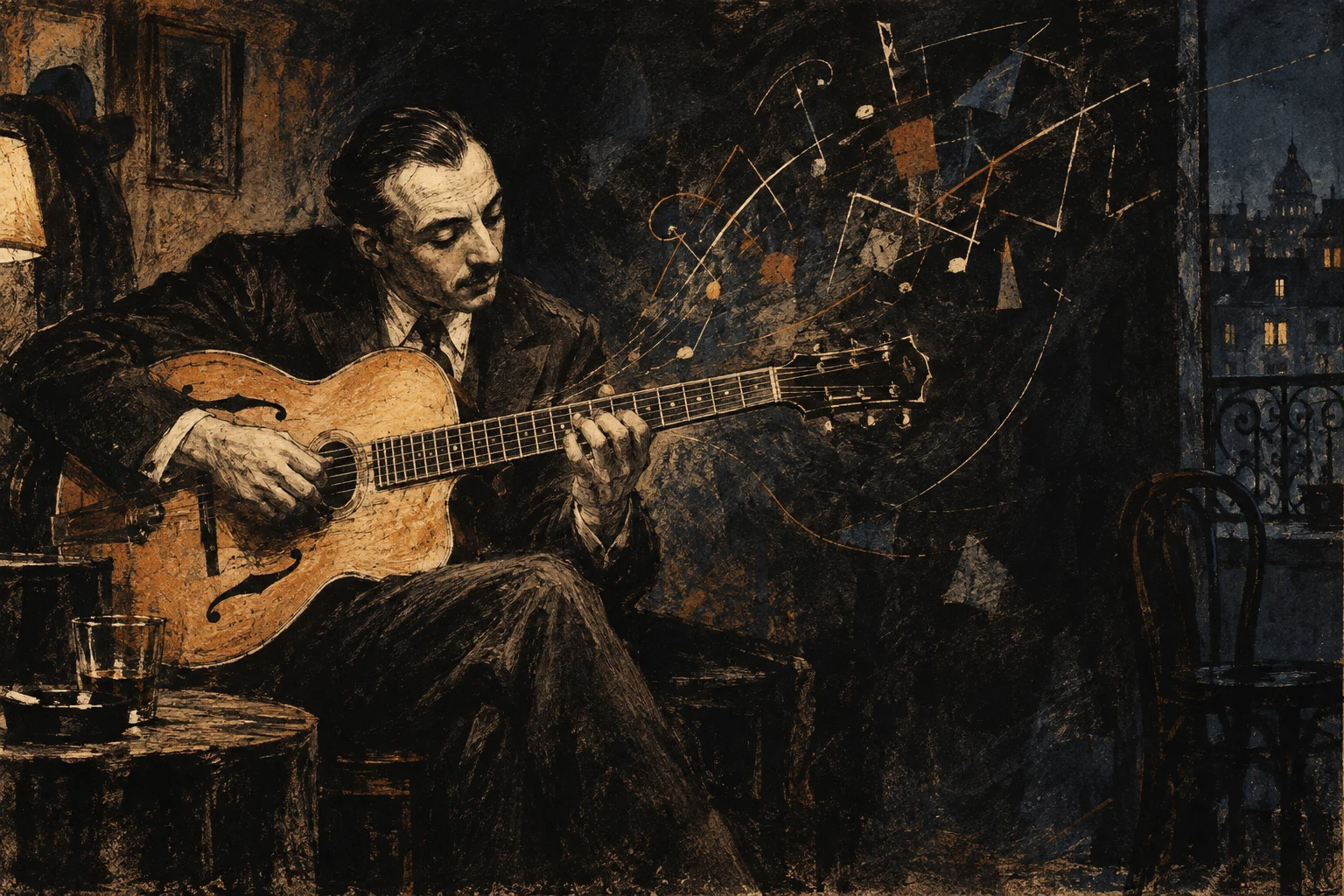
An original illustration inspired by the requested editorial concept. It is not an archival photograph or a documented depiction of a recording session.
Original Djangopedia illustration · AI-assisted, 2026
Illustration credits & provenance →Selected performances by notable Gypsy Jazz players and ensembles. Inclusion is editorial and does not imply an objective popularity ranking.
Notable Gypsy Jazz performances are being curated.
Keep one small rhythmic gesture recognizable while adapting its pitches to the local harmony.
This is an unaccompanied piece. Accompaniment study means coordinating bass, inner chords and melody within one guitar part. Practise each voice alone, then add only the necessary support notes.
Rubato: practise short gestures slowly, then restore their natural breathing. No fixed BPM range is assigned.
Choose a five-second gesture. Sing it, play its bass alone, then add the melody. Record an unaccompanied version with the original pauses before attempting the entire piece.
Use a steady click for measured passages; for Improvisation No. 1, remove it when restoring rubato phrasing.
Agree the version, key, count-in and ending before playing. This guide remains pending owner review.
Free-form unaccompanied solo; no repeating chorus chart established
Reduce the arrangement to melody, bass arrivals and essential support notes; let each line remain audible.
This is an unaccompanied piece. Accompaniment study means coordinating bass, inner chords and melody within one guitar part. Practise each voice alone, then add only the necessary support notes.
This guide studies an instrumental arrangement; no lyric attribution is asserted.
This player guide combines inherited recording evidence and editorial study notes. Musical study notes are editorial suggestions; compare them with the recording.
Djangopedia full discography ↗
Frémeaux complete Django edition — FA 305 ↗
Gypsy Swing as a Medium for Virtuosic Gestures — Ethnomusicology Review ↗
Original Djangopedia illustration · AI-assisted, 2026
An original illustration inspired by the requested editorial concept. It is not an archival photograph or a documented depiction of a recording session.
Generated with the native image-generation tool on 2026-10-07; original editorial artwork, not a historical photograph.
Prompt: Original editorial illustration for Django Reinhardt’s “Improvisation No. 1”. A solitary guitarist seated in a dim intimate 1930s room, guitar illuminated by a narrow pool of warm light, loose hand-drawn musical gestures and fragmented harmonic shapes emerging from the instrument and dissolving into darkness. Expressive monotype / drypoint print aesthetic with rough ink textures, deep charcoal, warm cream, burnt sienna and restrained dark blue. Emphasis on spontaneous musical thought, silence between phrases, fretboard and hands. Clearly illustrative and non-photographic, contemplative rather than dramatic, no text, no logo, no signature, no imitation of a historical photograph or specific artist. Landscape feature-image composition.
Feature artwork is an original Djangopedia illustration generated with the native tool. Composition and chart rights are not certified by owner review. Sources are linked; no historic photograph is substituted.