
Tune details
Music: Nacio Herb Brown
Words: Arthur Freed
Documented in archive: 1934
Original key: Not established
Study level: Intermediate listening study; arrangement and source awareness
 Djangopedia
From Now On appears among Patrick’s 1934 sides with Django. Track the melody’s long notes while listening for the guitar’s short connecting figures.
Hold a sung destination note over a quiet pulse; place a two-note guitar answer after its release, then compare the timing with the original phrase.
Owner content reviewed — 2026-10-19T23:29:17Z by admin. Coverage measures presence, not accuracy. Content review does not certify rights or musical perfection.
Django recordings for this tune. Uploader dates and take labels remain source claims; only an evidenced exact association enables a row’s Listen control.
Django Reinhardt
source-described; accuracy not independently verified
Uploader identifies this as Django Reinhardt’s performance; recording date and take require comparison with the discography.
| Entry | Year | Recording / session / release evidence | Listen |
|---|---|---|---|
| 01 | 1934 | From Now On,CPT 1700-1,"Fremeaux FA 302, Classics 703.",Nov.1934 - Paris - Patrick Et Son Orchestre featuring Django Reinhardt (g). | — |
A dash means no video has been associated with this exact historical recording. Tune-level listening resources remain available above.
From Now On appears among Patrick’s 1934 sides with Django. The inherited CPT 1700-1 reference agrees with the publisher’s title listing, and this context is distinct from later songs with the same words in their titles.
Music: Nacio Herb Brown
Words: Arthur Freed
Documented in archive: 1934
Original key: Not established
Study level: Intermediate listening study; arrangement and source awareness
Track the melody’s long notes while listening for the guitar’s short connecting figures. Source-attributed credits: Nacio Herb Brown and Arthur Freed, credited in the publisher booklet.
A complete harmonic route is not established here. First sing the melody and mark phrase endings; verify the underlying chords from a reliable edition before adding substitutions.
No verified complete chart is supplied. The listening and practice notes do not stand in for a chord chart.
No readable chord chart has been added for this title.
No backing track has been added.
Performed studies, transcriptions, TAB, notation and lessons for studying Django’s solo. Inclusion does not certify note-for-note accuracy.
No Django solo study aid yet. Know a useful resource — or want to record a study of this solo?
Follow a shared key, a harmonic idea or a familiar form. Keys refer to this site’s chart editions; other recordings may use a different key.
No sufficiently supported harmonic comparison has been added yet.
No match is established in the current chart metadata.
No match is established in the current chart metadata.
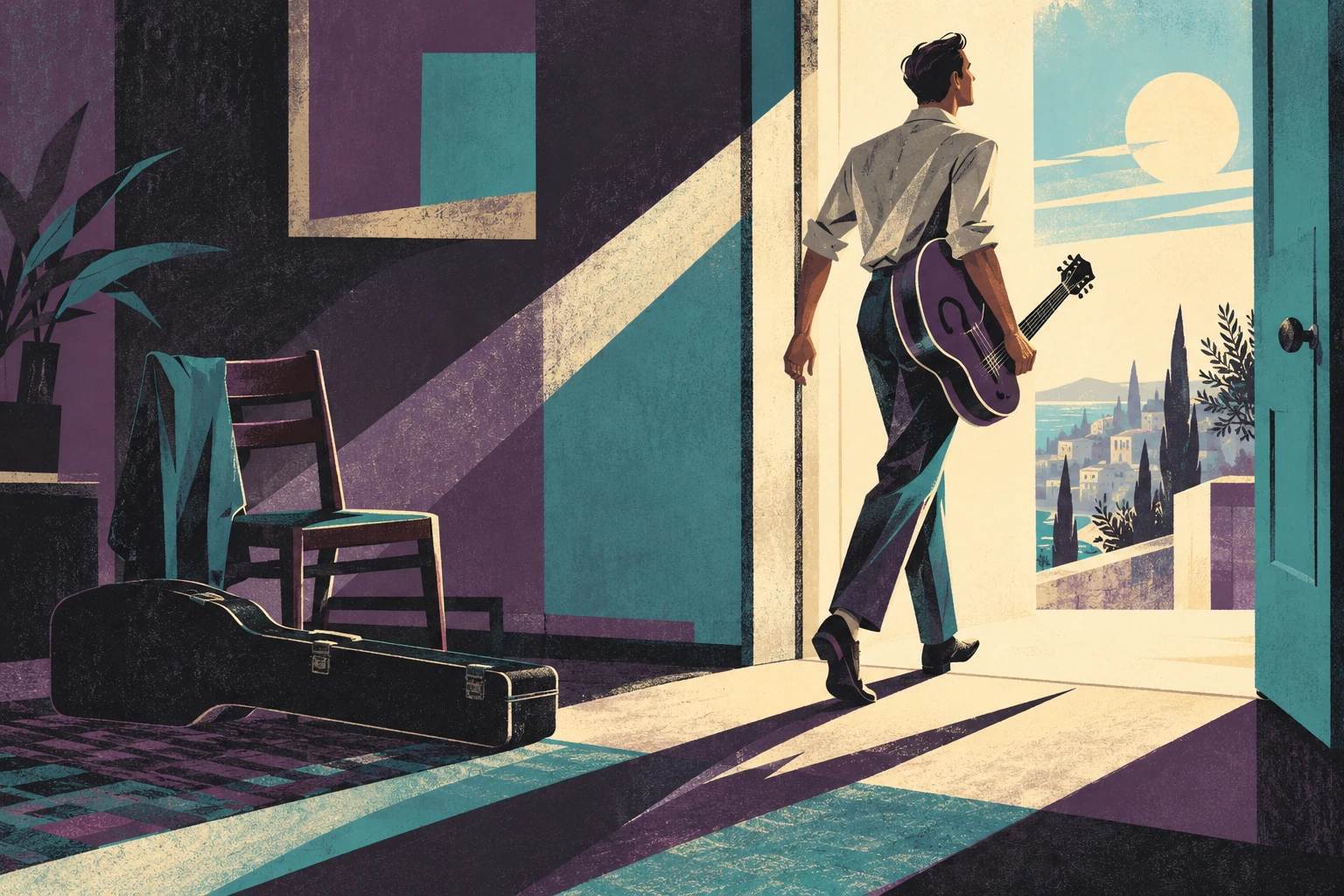
This image is an editorial illustration; a connection to this recording has not been established.
Original AI-assisted editorial artwork inspired by the tune’s mood; not a documented historical scene.
Original AI-assisted illustration created for Djangopedia
Illustration credits & provenance →Selected performances by notable Gypsy Jazz players and ensembles. Inclusion is editorial and does not imply an objective popularity ranking.
Notable Gypsy Jazz performances are being curated.
Hold a sung destination note over a quiet pulse; place a two-note guitar answer after its release, then compare the timing with the original phrase.
Keep the singer’s sustained notes free of busy chord decoration; use a deliberate cutoff for each reply.
60–90 quarter-note BPM for short study fragments; slow the source as needed
Hold a sung destination note over a quiet pulse; place a two-note guitar answer after its release, then compare the timing with the original phrase.
Use a quiet quarter-note click for short loops. Keep the preceding rest and the next entry in the loop; remove the click briefly to test internal time.
Confirm the composition identity, concert key and complete arrangement before calling the tune. Agree pickup and ending together.
Do not use unrelated later compositions called From Now On to fill a media gap.
Begin with the melody alone, then add only independently established bass arrivals. Keep the singer’s sustained notes free of busy chord decoration; use a deliberate cutoff for each reply.
Keep the singer’s sustained notes free of busy chord decoration; use a deliberate cutoff for each reply.
Follow the song’s breathing where a vocal version exists. Establish the singer’s key independently; lyrics are not reproduced here.
This player guide combines inherited recording evidence and editorial study notes. Musical study notes are editorial suggestions; compare them with the recording.
Djangopedia full discography ↗
Reissue publisher booklet and track listing ↗
Original AI-assisted illustration created for Djangopedia
Original AI-assisted editorial artwork inspired by the tune’s mood; not a documented historical scene.
Generated with the native image-generation tool on 2026-10-20; original editorial artwork, not a historical photograph.
Prompt: Use case: stylized-concept. Create one horizontal 1536x1024, 3:2 original Djangopedia tune illustration for From Now On. Scene: An adult guitarist steps through an open doorway toward morning light; a chair and closed instrument case remain behind. Crisp geometric shadows and optimistic restrained energy. Medium: 1950s serigraph editorial print, bold simplified flat separate ink layers, elongated expressive angular figures, wiry line accents, subtle off-register overlaps, selective dry-ink texture and small crosshatched areas. Sophisticated mid-century jazz print, strong asymmetric composition and generous negative space. Palette: muted violet, turquoise, warm ivory and charcoal. Keep all heads, hands and instrument bodies inside frame. No words, letters, numbers, labels, logos, watermark, borders, gradients, photorealism or photographed paper. Entirely original composition; not a reproduction of an existing print or a documented historical scene.