
Tune details
Music: Nick LaRocca (credit in the cited 1917 edition)
Source-attributed publication / composition: 1917
Original key: Not established
Study level: Advanced; form, breaks and ensemble coordination
 Djangopedia
A high-energy ensemble study whose section changes and breaks matter just as much as its speed.
Make a spoken roadmap while listening: name each section and count its repetitions.
Owner content reviewed — 2026-10-18T01:20:04Z by admin. Coverage measures presence, not accuracy. Content review does not certify rights or musical perfection.
Django recordings for this tune. Uploader dates and take labels remain source claims; only an evidenced exact association enables a row’s Listen control.
Django Reinhardt
source-described; accuracy not independently verified
Uploader identifies this as Django Reinhardt’s performance; recording date and take require comparison with the discography.
| Entry | Year | Recording / session / release evidence | Listen |
|---|---|---|---|
| 01 | 1934 | Tiger Rag, Aug. 1934,"Fremeaux FA 302, Classics 703."," - Paris - Django Reinhardt, Joseph Reinhardt (g), Juan Fernandez (b)." | — |
| 02 | 1934 | Tiger Rag, Dec.1934, P 77162,"Fremeaux FA 302, Classics 703, JSP 341, Jazz Archives- ZET 752, Vogue 668003-1."," - Paris - QHCF: Stephane Grappelly (v), Django Reinhardt, Joseph Reinhardt, Roger Chaput (g), Louis Vola (b)." | — |
| 03 | 1937 | Tiger Rag, 7/7/37, OLA 1891-1 ,"Fremeaux 306, Classics 748, EMI 780671"," - Paris - Andre Ekyan (as), Django Reinhardt (g)" | — |
| 04 | — | Tiger Rag, Spring 1939, Acetate,Fremeaux FA 309,", Stephane Grappelli ?(v), Django Reinhardt?(g), and possibly Joseph Reinhardt, Barro Ferret (g), Emmanuel Soudieux (b)" | — |
| 05 | 1940 | Tiger Rag, 21/10/40, OSW 136-1 ,"Fremeaux FA 310, Classics 751, EMI 780671-3", - Paris - Alix Combelle et Son Orchestre featuring Django Reinhardt (g) | — |
| 06 | 1947 | Tiger Rag, Nov. 1947, "Fremeaux FA 315, Vogue 228E 6008, Vogue 600121", RTF Broadcast | — |
| 07 | 1947 | Tiger Rag (alt), Nov. 1947, Fremeaux FA 316, - RTF Broadcast | — |
| 08 | 1947 | Tiger Rag (alt),Fremeaux FA 316,Nov. 1947 - As above - RTF Broadcast | — |
A dash means no video has been associated with this exact historical recording. Tune-level listening resources remain available above.
The Library of Congress holds a 1917 printed edition credited to Nick LaRocca and recognizes the Original Dixieland Jazz Band’s 1918 recording. That catalogue credit is not a claim that the tune’s disputed origins are settled. The Djangopedia identity contains seven historical rows, including an alternate-take entry and one uncertain attribution. Those details remain intact. This is Tiger Rag, not Django’s Tiger.
Music: Nick LaRocca (credit in the cited 1917 edition)
Source-attributed publication / composition: 1917
Original key: Not established
Study level: Advanced; form, breaks and ensemble coordination
Compare the opening and ending across two archive recordings before selecting a jam arrangement. The uncertain historical attribution remains an uncertainty.
Tiger Rag, Aug. 1934,"Fremeaux FA 302, Classics 703."," - Paris - Django Reinhardt, Joseph Reinhardt (g), Juan Fernandez (b)."
Treat the tune as a sequence of strains, not a generic thirty-two-bar song. Before improvising, agree which section supplies the solo changes, where the breaks occur and how the final return is cued. Use the creator’s chart for the selected play-along; the inherited image reference alone does not establish a readable, verified local chart. Check the video key before playing with the chart.
Treat the tune as a sequence of strains, not a generic thirty-two-bar song. Before improvising, agree which section supplies the solo changes, where the breaks occur and how the final return is cued. Use the creator’s chart for the selected play-along; the inherited image reference alone does not establish a readable, verified local chart.
Existing chart material is retained without transcription changes. Linked teaching editions are external references, not newly licensed charts. Match their key and arrangement to your chosen recording.
No readable chord chart has been added for this title.
Stephane Wrembel
Swing · 138 BPM · 1m50s · Video available when checked; creator-described attribution.
Creator-described gypsy-jazz play-along. Check the key and full arrangement before joining in; the guide chart may use another key. Tempo is the creator’s stated value. Creator tempo label may use a half-time pulse; confirm against the audible count-in.
If playback is unavailable, use the source link.
 TIGER RAG (138BPM) THE STEPHANE WREMBEL BAND - PLAY ALONG SERIESStephane WrembelSwing · 138 BPM · 1m50s · Video available when checked; creator-described attribution.Creator-described gypsy-jazz play-along. Check the key and full arrangement before joining in; the guide chart may use another key. Tempo is the creator’s stated value. Creator tempo label may use a half-time pulse; confirm against the audible count-in.✓ Featured
 Tiger rag : play-back n°049a (Nuages de Swing 100 years Django 100 new play-a-long)Laurent Courtois et Nuages de Swing3m40s · Video available when checked; creator-described attribution.Creator-described gypsy-jazz play-along. Check the key and full arrangement before joining in; the guide chart may use another key.Select video
Performed studies, transcriptions, TAB, notation and lessons for studying Django’s solo. Inclusion does not certify note-for-note accuracy.
Antonis Arfanis
source-described; accuracy not independently verified
Creator presents a study of Django’s recorded solo. Use it alongside the original recording; exact transcription accuracy has not been independently reviewed.
If playback is unavailable, use the source link.
Follow a shared key, a harmonic idea or a familiar form. Keys refer to this site’s chart editions; other recordings may use a different key.
No sufficiently supported harmonic comparison has been added yet.
No match is established in the current chart metadata.
No match is established in the current chart metadata.
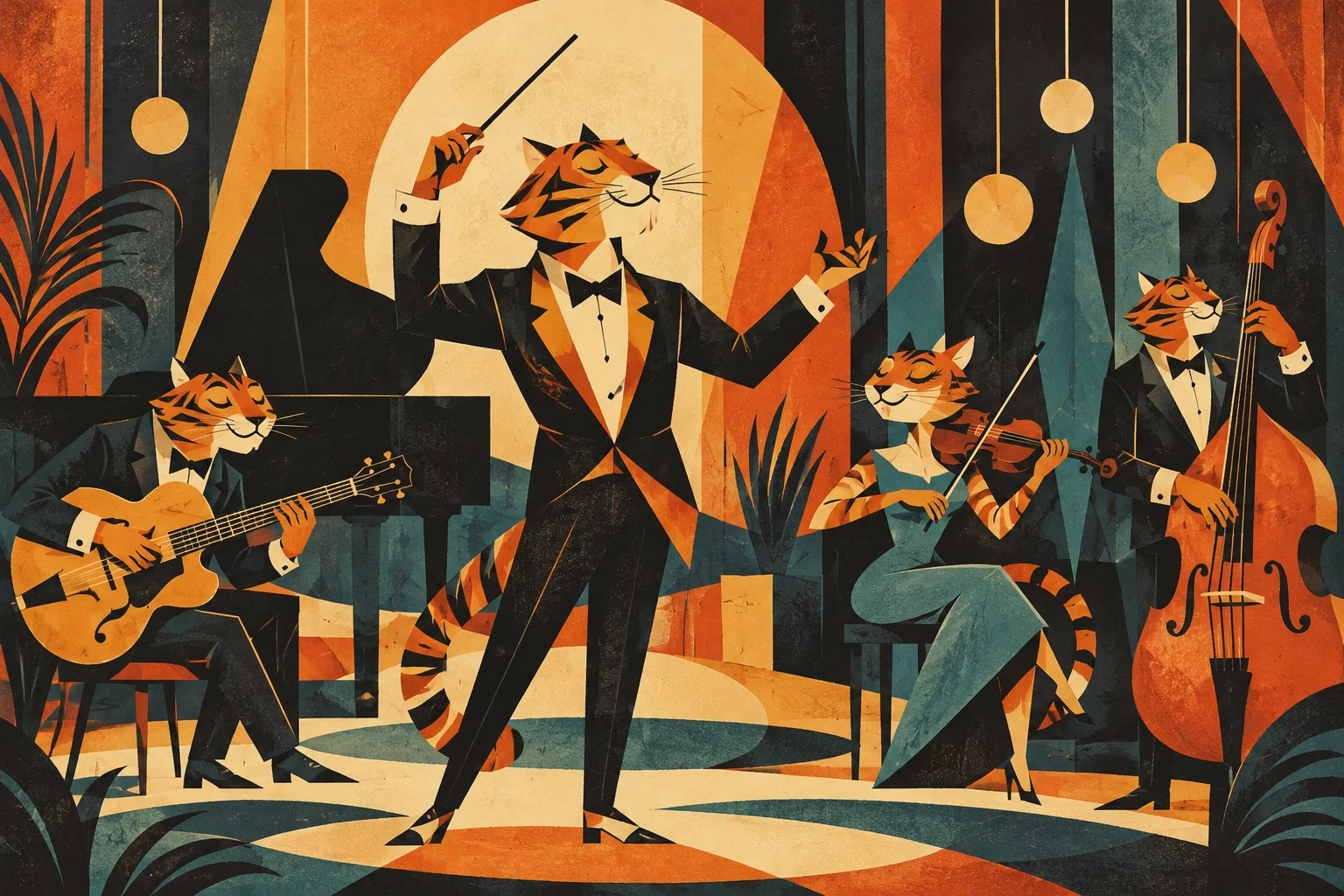
A stylized tiger conducts a guitar, violin and bass ensemble.
Original AI-assisted editorial artwork inspired by the tune’s mood. It does not depict a documented historical event.
Original Djangopedia illustration · AI-assisted, 2026
Illustration credits & provenance →Selected performances by notable Gypsy Jazz players and ensembles. Inclusion is editorial and does not imply an objective popularity ranking.
Tony Green
Video available when checked; creator-described attribution.
Performer attribution follows the video title and channel description. Proposed listening selection; no popularity ranking implied.
If playback is unavailable, use the source link.
 TONY GREEN & GYPSY JAZZ ~ "TIGER RAG" ~ VENICE, ITALY 1993Tony GreenVideo available when checked; creator-described attribution.Performer attribution follows the video title and channel description. Proposed listening selection; no popularity ranking implied.✓ Featured
 Tiger Rag - Fernando Castiñeiras Gypsy Quinteto + R.Pellican. Django Festival 2024 en BeBop Club.Ricardo PellicanVideo available when checked; creator-described attribution.Performer attribution follows the video title and channel description. Proposed listening selection; no popularity ranking implied.Select video
Make a spoken roadmap while listening: name each section and count its repetitions. Rehearse every break at half speed with a partner. Increase tempo only after three complete passes with identical section lengths and a clean ending.
Keep chord strokes short and accents coordinated with the band. Silence at a break is an ensemble event, not an opportunity to continue strumming.
Practice each section at 90–120 bpm before attempting a fast full arrangement
Make a spoken roadmap while listening: name each section and count its repetitions. Rehearse every break at half speed with a partner. Increase tempo only after three complete passes with identical section lengths and a clean ending.
Count quarter notes first. Then place the click on beats 2 and 4 at half the click rate, keeping the phrase length unchanged.
Confirm the chosen arrangement key; Multi-strain rag; head, repeated sections and solo route must be agreed. Agree the arrangement, pickup and ending before counting in.
Tiger Rag and Django’s Tiger are different tunes. A fast backing track for the latter is not a substitute.
Keep the melody uppermost and begin with a single bass note under each harmony. Use small voicings that allow immediate damping; rehearse release timing with the fretting hand.
Keep chord strokes short and accents coordinated with the band. Silence at a break is an ensemble event, not an opportunity to continue strumming.
No vocal arrangement is prescribed; use the instrumental melody as the phrasing reference.
This player guide combines inherited recording evidence and editorial study notes. Musical study notes are editorial suggestions; compare them with the recording.
Library of Congress — 1917 printed edition ↗
Library of Congress — 1918 recording ↗
Stéphane Wrembel creator play-along ↗
Original Djangopedia illustration · AI-assisted, 2026
Original AI-assisted editorial artwork inspired by the tune’s mood. It does not depict a documented historical event.
Generated with the native image-generation tool on 2026-10-17; original editorial artwork, not a historical photograph.
Prompt: Create one original Djangopedia tune-guide editorial illustration. Landscape 3:2, 1536x1024. Broad mid-century jazz record sleeve and Art Deco graphic traditions: bold confident outlines, flat geometric shapes, subtle vintage paper print texture, sophisticated playful composition. No imitation of a specific artist, no lettering, no logo, no watermark, no photorealism. Keep important subjects within central 80% for responsive cropping. Fictional atmospheric interpretation, not a documented historical event. A whimsical angular tiger conducting a tiny jazz ensemble of guitar, violin and bass; dancing striped rhythmic shapes, lively vintage stage. Orange, charcoal, cream, muted turquoise. Sophisticated playful poster, no text.
