
Tune details
Music: Django Reinhardt
Documented in archive: 1939
Original key: Not established
Study level: Intermediate / advanced: contrasting head and solo roadmaps.
 Djangopedia
Follow the A♭ riff head into a blues-derived solo chorus, then treat the ending as its own arrangement cue.
At 100 BPM, count and comp the head without soloing. Then play one 12-bar solo chorus using only chord tones. Practise the transition and ending as separate loops.
Owner content reviewed — 2026-10-07T14:40:31Z by admin. Coverage measures presence, not accuracy. Content review does not certify rights or musical perfection.
Django recordings for this tune. Uploader dates and take labels remain source claims; only an evidenced exact association enables a row’s Listen control.
Uploader identifies this as Django Reinhardt’s performance; recording date and take require comparison with the discography.
| Entry | Year | Recording / session / release evidence | Listen |
|---|---|---|---|
| 01 | 1939 | Stockholm, 30/6/39, OPG 1719-1 ,"Fremeaux FA 309, Classics 813, Affinity AFS 1003, Jazz Time 251270-2, Jazz Archives 157222, Mosaic MD6-190(6 CD Set)."," - Paris - QHCF - Stephane Grappelly (v), Django Reinhardt, Eugene Vees, Pierre Ferret (g), Emmanuel Soudieux (b)" | — |
| 02 | — | Stockholm,OSW 174-1 ,"Fremeaux FA 311, Classics 852, OR0062, HEP 1041, Jazz Time 799991-2" | — |
| 03 | 1947 | Stockholm, 7-15-22/9/47, "Fremeaux FA 314, Classics 1046, Vogue 228E 6006, Legacy 411(""Scandinavia"")"," - Paris - Souvenirs de Django - Django Reinhardt (elg), Hubert Rostaing (cl), Eugene Vees (g), Emmanuel Soudieux (b), Andre Jourdan (d)" | — |
A dash means no video has been associated with this exact historical recording. Tune-level listening resources remain available above.
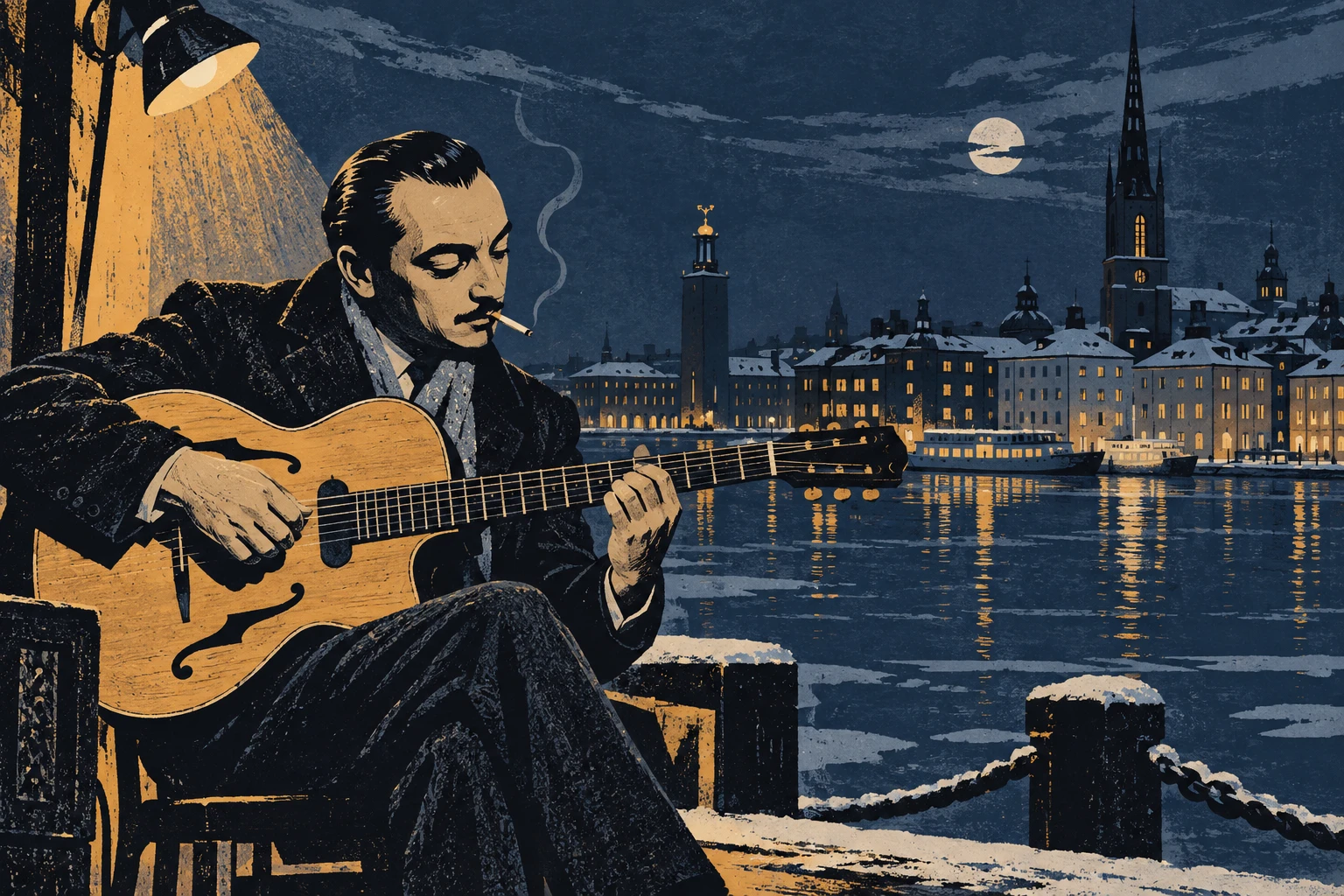
The label edition identifies the 1939 Stockholm recording as OPG 1719-1. The archive contains three rows, including a later 1947 entry and one row whose date remains unresolved. The nocturnal illustration is imaginative artwork; it is not evidence of a Stockholm recording session.
Music: Django Reinhardt
Documented in archive: 1939
Original key: Not established
Study level: Intermediate / advanced: contrasting head and solo roadmaps.
Keep the repeated riff rhythm stable, then change your counting for the solo chorus. Hear altered dominant colour as a tension against the A♭ centre. Aim for a clear resolution instead of filling every space with chromatic notes.
Study reductions of the source’s separate riff and solo maps. Slash basses, alternate chords and the dedicated ending are not fully reproduced; use the linked source and recording to agree those details.
No backing track has been added.
Performed studies, transcriptions, TAB, notation and lessons for studying Django’s solo. Resources are described by their creator; inclusion does not certify note-for-note accuracy.
augusto creni · source-described; accuracy not independently verified
Creator presents a study of Django’s recorded solo. Use it alongside the original recording; exact transcription accuracy has not been independently reviewed.
Checked 2026-10-02
Follow a shared key, a harmonic idea or a familiar form. Keys refer to this site’s chart editions; other recordings may use a different key.
No sufficiently supported harmonic comparison has been added yet.
No match is established in the current chart metadata.
Follow the A♭ riff head into a blues-derived solo chorus, then treat the ending as its own arrangement cue.
An original illustration inspired by the requested editorial concept. It is not an archival photograph or a documented depiction of a recording session.
Original Djangopedia illustration · AI-assisted, 2026
Illustration credits & provenance →Selected performances by notable Gypsy Jazz players and ensembles. Inclusion is editorial and does not imply an objective popularity ranking.
Rêve Bohème · Reveboheme
2006 · Copenhagen concert, February 2006
A modern ensemble reading from the band's own channel. Compare the head-to-solo transition and the ending with the historical recordings.
If playback is unavailable, use the source link.
Keep one small rhythmic gesture recognizable while adapting its pitches to the local harmony.
Rehearse the 16-bar head and 12-bar solo cycle separately. Keep the bass and lead coordinated at the change of roadmap. Agree the written ending before starting, rather than assuming one more normal chorus.
Start at 90–110 BPM; rehearse the head-to-solo transition before increasing speed.
At 100 BPM, count and comp the head without soloing. Then play one 12-bar solo chorus using only chord tones. Practise the transition and ending as separate loops.
Begin with four quarter-note clicks, then place clicks on beats 2 and 4 without changing the phrase length.
Agree the version, key, count-in and ending before playing. This guide remains pending owner review.
16-bar riff head; 12-bar blues-derived solo chorus; separate ending
Reduce the arrangement to melody, bass arrivals and essential support notes; let each line remain audible.
Rehearse the 16-bar head and 12-bar solo cycle separately. Keep the bass and lead coordinated at the change of roadmap. Agree the written ending before starting, rather than assuming one more normal chorus.
This guide studies an instrumental arrangement; no lyric attribution is asserted.
This player guide combines inherited recording evidence and editorial study notes. Musical study notes are editorial suggestions; compare them with the recording.
Frémeaux complete Django edition — FA 309 ↗
Frémeaux complete Django edition — FA 314 ↗
The Transcribed Gypsy Jazz Chordbook — Martin Gioani, page 174 ↗
Original Djangopedia illustration · AI-assisted, 2026
An original illustration inspired by the requested editorial concept. It is not an archival photograph or a documented depiction of a recording session.
Generated with the native image-generation tool on 2026-10-07; original editorial artwork, not a historical photograph.
Prompt: Atmospheric editorial illustration of Django Reinhardt playing guitar in Stockholm at night, Nordic modernist screenprint / woodcut aesthetic. Deep indigo and blue-grey night, amber windows and stage light, simplified waterfront/city geometry, crisp carved textures and restrained shapes. Django and guitar rendered as an elegant graphic figure with enough historical character to suggest Django Reinhardt without looking photographic. Quiet, sophisticated, wintry jazz mood. Original illustration, no text, no logos, no copying an existing photograph. Landscape feature image.
Feature artwork is an original Djangopedia illustration generated with the native tool. Composition and chart rights are not certified by owner review. Sources are linked; no historic photograph is substituted.
