Tune details
Music: Slim Gaillard, Slam Stewart
Words: Bud Green
Documented in archive: 1938
Original key: Not established
Study level: Intermediate; melody, pulse and arrangement awareness
 Djangopedia
A playful swing song for call and response, short answers and relaxed time.
Speak the head rhythm without lyrics, clap it against a steady pulse, then play a two-note answer.

Owner content reviewed — 2026-10-19T04:10:09Z by admin. Coverage measures presence, not accuracy. Content review does not certify rights or musical perfection.
Django recordings for this tune. Uploader dates and take labels remain source claims; only an evidenced exact association enables a row’s Listen control.
Django Reinhardt
source-described; accuracy not independently verified
Uploader identifies this as Django Reinhardt’s performance; recording date and take require comparison with the discography.
| Entry | Year | Recording / session / release evidence | Listen |
|---|---|---|---|
| 01 | 1938 | The Flat Foot Floogie,DR 2878-1,"Fremeaux FA 308, JSP 342, Classics 793, Music Memoria 87948","14/6/38 - Paris - QHCF - Stepane Grappelly (v), Django Reinhardt (g), Joseph Reinhardt, Eugene Vees (g), Roger Grasset (b)" | — |
A dash means no video has been associated with this exact historical recording. Tune-level listening resources remain available above.
This Gaillard–Stewart swing number sits in the archive with the late-1930s string-quintet repertory. Its playful vocal character is useful even in an instrumental arrangement.
Music: Slim Gaillard, Slam Stewart
Words: Bud Green
Documented in archive: 1938
Original key: Not established
Study level: Intermediate; melody, pulse and arrangement awareness
A playful swing song for call and response, short answers and relaxed time.
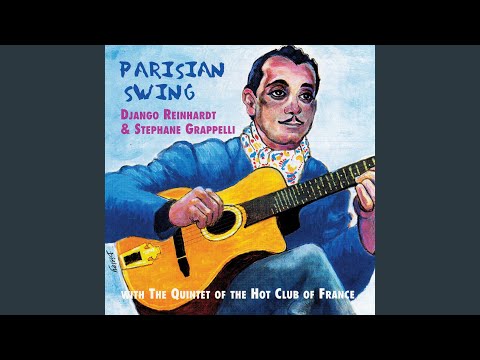
The Flat Foot Floogie,DR 2878-1,"Fremeaux FA 308, JSP 342, Classics 793, Music Memoria 87948","14/6/38 - Paris - QHCF - Stepane Grappelly (v), Django Reinhardt (g), Joseph Reinhardt, Eugene Vees (g), Roger Grasset (b)"
Hear the recurring head figure as a rhythmic unit, not a scale exercise. Locate its cadence in one chosen performance before filling the harmony. Check the video key before playing with the chart.
Hear the recurring head figure as a rhythmic unit, not a scale exercise. Locate its cadence in one chosen performance before filling the harmony.
No complete verified chart is supplied. The exercises are listening and practice suggestions, not a substitute score.
No readable chord chart has been added for this title.
Luc Maes
Swing · 160 BPM · 5m7s · Video available when checked; creator-described attribution.
Creator-provided play-along; instrumentation and feel vary by selection. Check the key and full arrangement before joining in; the guide chart may use another key. Tempo is the creator’s stated value.
If playback is unavailable, use the source link.
Performed studies, transcriptions, TAB, notation and lessons for studying Django’s solo. Inclusion does not certify note-for-note accuracy.
No Django solo study aid yet. Know a useful resource — or want to record a study of this solo?
Follow a shared key, a harmonic idea or a familiar form. Keys refer to this site’s chart editions; other recordings may use a different key.
No sufficiently supported harmonic comparison has been added yet.
No match is established in the current chart metadata.
No match is established in the current chart metadata.
A humorous low-angle dance scene, three dancers with exaggerated flat two-tone shoes and zigzag knees, with a small acoustic bass in the distance.
Original AI-assisted editorial artwork inspired by the tune’s mood. It does not depict a documented historical event.
Original AI-assisted illustration created for Djangopedia
Illustration credits & provenance →Selected performances by notable Gypsy Jazz players and ensembles. Inclusion is editorial and does not imply an objective popularity ranking.
Romain Vuillemin
Video available when checked; creator-described attribution.
Performer attribution follows the video title and channel description. Proposed listening selection; no popularity ranking implied.
If playback is unavailable, use the source link.
Speak the head rhythm without lyrics, clap it against a steady pulse, then play a two-note answer. Keep each answer shorter than the original call.
Use a relaxed, bouncing pulse and avoid accelerating when the repeated figure becomes more animated. Agree any vocal breaks before starting.
80–120 bpm, then increase gradually
Speak the head rhythm without lyrics, clap it against a steady pulse, then play a two-note answer. Keep each answer shorter than the original call.
Count quarter notes first. Then place the click on beats 2 and 4 at half the click rate, keeping the phrase length unchanged.
Confirm the chosen arrangement key; Confirm the complete form. Agree the arrangement, pickup and ending before counting in.
A bass or vocal solo study is not a Django guitar-solo recreation.
Keep the melody uppermost and begin with a single bass note under each harmony. Use a relaxed, bouncing pulse and avoid accelerating when the repeated figure becomes more animated. Agree any vocal breaks before starting.
Use a relaxed, bouncing pulse and avoid accelerating when the repeated figure becomes more animated. Agree any vocal breaks before starting.
Choose a comfortable singing key and transpose the accompaniment as a whole; lyrics are not reproduced here.
This player guide combines inherited recording evidence and editorial study notes. Musical study notes are editorial suggestions; compare them with the recording.
Djangopedia full discography ↗
Reissue publisher discography and credits ↗
Inherited chart and recording evidence
Original AI-assisted illustration created for Djangopedia
Original AI-assisted editorial artwork inspired by the tune’s mood. It does not depict a documented historical event.
Generated with the native image-generation tool on 2026-10-19; original editorial artwork, not a historical photograph.
Prompt: Use case: stylized-concept. Asset: horizontal 1536x1024, 3:2 Djangopedia tune illustration for The Flat Foot Floogie. Original scene: A humorous low-angle dance scene, three dancers with exaggerated flat two-tone shoes and zigzag knees, with a small acoustic bass in the distance. Medium: authentic-feeling 1950s silk-screen editorial print, flat separate ink layers, boldly simplified shapes, long expressive angular silhouettes, spare wiry line accents, off-register overlaps, small areas of crosshatching, slight dry ink and paper texture. Strong asymmetric composition with generous negative space; witty and musical, sophisticated rather than children's cartoon. Limited palette: slate blue, dusty pink, pale butter yellow and ink black. All heads and instrument bodies wholly inside frame unless otherwise specified. No letters, words, numbers, captions, borders, logos, watermark, realistic shading, gradients or photographed paper. Invent an entirely new composition, not a reproduction of any existing print. No claim of a documented historical scene.

