Tune details
Music:
Documented in archive: Not established
Original key: Not established
Study level: Intermediate listening study; arrangement and source awareness
 Djangopedia
This song is firmly represented in modern Gypsy-jazz repertoire, but the inherited Django evidence is not settled. Compare the vocal phrasing of Marion & Sobo with the guitar-led modern versions.
Sing a full melodic sentence over the proposed backing at a slower playback rate.

Owner content reviewed — 2026-10-19T21:28:53Z by admin. Coverage measures presence, not accuracy. Content review does not certify rights or musical perfection.
Django recordings for this tune. Uploader dates and take labels remain source claims; only an evidenced exact association enables a row’s Listen control.
No Django listening resource has been added.
| Entry | Year | Recording / session / release evidence | Listen |
|---|---|---|---|
| 01 | — | Que Reste-t-il nos Amour,WL 221,(unissued)**(wrongly described as OSW 323-1 17/2/43),"Jan-Feb 1949 - Rome - Django Reinhardt (g), Stephane Grappelly (v),Gianni Safred (p), Carlo Pecori (b), Aurelio de Carolis (d)." | — |
A dash means no video has been associated with this exact historical recording. Tune-level listening resources remain available above.
This song is firmly represented in modern Gypsy-jazz repertoire, but the inherited Django evidence is not settled. Its archive row includes an unissued WL221 reference and conflicting date information. The research did not establish a reliable Django listening video, so modern covers are not presented as Django’s own recording.
Music:
Documented in archive: Not established
Original key: Not established
Study level: Intermediate listening study; arrangement and source awareness
Compare the vocal phrasing of Marion & Sobo with the guitar-led modern versions. Let the song’s long lines determine breathing and accompaniment density rather than imitating an assumed historical Django solo. Source-attributed credits: Charles Trenet — source-associated; full composition roles unresolved
A complete harmonic route is not established here. First sing the melody and mark phrase endings; verify the underlying chords from a reliable edition before adding substitutions.
No verified complete chart is supplied. The listening and practice notes do not stand in for a chord chart.
No readable chord chart has been added for this title.
Clément Reboul
128 BPM · 6m10s · Public, processed and embeddable when checked; creator-described identity.
Creator-provided play-along. Confirm the concert key, complete roadmap and count-in before joining; it is not certified as the historical arrangement. Tempo is the creator’s stated value. Creator counts half notes: 64 half notes per minute equals 128 quarter notes per minute.
If playback is unavailable, use the source link.
Performed studies, transcriptions, TAB, notation and lessons for studying Django’s solo. Inclusion does not certify note-for-note accuracy.
No Django solo study aid yet. Know a useful resource — or want to record a study of this solo?
Follow a shared key, a harmonic idea or a familiar form. Keys refer to this site’s chart editions; other recordings may use a different key.
No sufficiently supported harmonic comparison has been added yet.
No match is established in the current chart metadata.
No match is established in the current chart metadata.
This image is an editorial illustration; a connection to this recording has not been established.
Original AI-assisted editorial artwork inspired by the tune’s mood; not a documented historical scene.
Original AI-assisted illustration created for Djangopedia
Illustration credits & provenance →Selected performances by notable Gypsy Jazz players and ensembles. Inclusion is editorial and does not imply an objective popularity ranking.
Marion & Sobo Band
Public, processed and embeddable when checked; creator-described identity.
Performer and tune attribution follow the named creator/distributor metadata. Proposed listening selection; no ranking or exact historical-take equivalence is implied.
If playback is unavailable, use the source link.
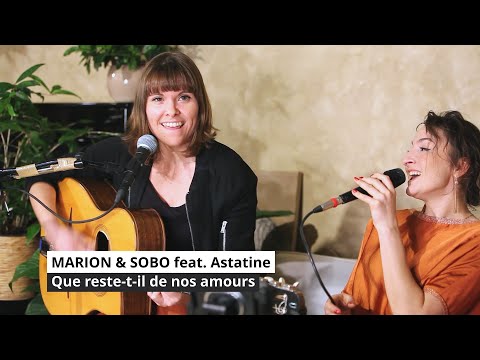 Que reste-t-il de nos amours - MARION & SOBO feat. AstatineMarion & Sobo BandPublic, processed and embeddable when checked; creator-described identity.Performer and tune attribution follow the named creator/distributor metadata. Proposed listening selection; no ranking or exact historical-take equivalence is implied.✓ Featured
 Noé Reinhardt, Samy Daussat, Katia Schiavone - Que reste-t-il de nos amours ?Label OuestPublic, processed and embeddable when checked; creator-described identity.Performer and tune attribution follow the named creator/distributor metadata. Proposed listening selection; no ranking or exact historical-take equivalence is implied. The video is a 3:05 individual track; its description also includes an album-wide tracklist.Select video
 Thomas Dutronc Rosenberg Gresset Festival Django Reinhardt 2023 (2) Que reste-t-il de nos amours ?Daniel Gueli Gypsy Jazz ChannelPublic, processed and embeddable when checked; creator-described identity.Performer and tune attribution follow the named creator/distributor metadata. Proposed listening selection; no ranking or exact historical-take equivalence is implied.Select video
Sing a full melodic sentence over the proposed backing at a slower playback rate. Play it on guitar with the same rests, then improvise an answer using only the last few notes of the sentence.
Keep the accompaniment gentle enough for a long vocal line. A creator counts the proposed backing at 64 half notes per minute, equivalent to 128 quarter notes; distinguish that convention from a measured historical tempo.
DjangoKOR presents the theme with notation. This is a melody aid, not evidence that Django recorded the tune or a recreation of his solo.
60–90 quarter-note BPM for short study fragments; slow the source as needed
Sing a full melodic sentence over the proposed backing at a slower playback rate. Play it on guitar with the same rests, then improvise an answer using only the last few notes of the sentence.
Use a quiet quarter-note click for short loops. Keep the preceding rest and the next entry in the loop; remove the click briefly to test internal time.
Confirm the composition identity, concert key and complete arrangement before calling the tune. Agree pickup and ending together.
Django recording attribution remains unresolved, including inherited date evidence. The theme lesson and modern performances do not prove a Django recording; that listening gap stays visible.
Begin with the melody alone, then add only independently established bass arrivals. Keep the accompaniment gentle enough for a long vocal line. A creator counts the proposed backing at 64 half notes per minute, equivalent to 128 quarter notes; distinguish that convention from a measured historical tempo.
Keep the accompaniment gentle enough for a long vocal line. A creator counts the proposed backing at 64 half notes per minute, equivalent to 128 quarter notes; distinguish that convention from a measured historical tempo.
Follow the song’s breathing where a vocal version exists. Establish the singer’s key independently; lyrics are not reproduced here.
This player guide combines inherited recording evidence and editorial study notes. Musical study notes are editorial suggestions; compare them with the recording.
Djangopedia full discography ↗
Reissue publisher booklet and track listing ↗
Original AI-assisted illustration created for Djangopedia
Original AI-assisted editorial artwork inspired by the tune’s mood; not a documented historical scene.
Generated with the native image-generation tool on 2026-10-19; original editorial artwork, not a historical photograph.
Prompt: Use case: stylized-concept. Create one horizontal 1536x1024, 3:2 original Djangopedia tune illustration for Que Reste-t-il nos Amour. Scene: An empty riverside cafe table with a folded scarf, a small photograph frame without facial detail, a guitar case and autumn leaves; generous wistful negative space. Medium: 1950s serigraph editorial print, bold simplified flat separate ink layers, elongated expressive angular figures, wiry line accents, subtle off-register overlaps, selective dry-ink texture and small crosshatched areas. Sophisticated mid-century jazz print, witty and musical rather than children's cartoon. Strong asymmetric composition and generous negative space. Palette: petrol teal, coral red, warm cream and black. Keep all heads and instrument bodies within frame. No words, letters, numbers, labels, watermark, borders, gradients, photorealism or photographed paper. Entirely original composition; not a reproduction of an existing print or a documented historical scene.
