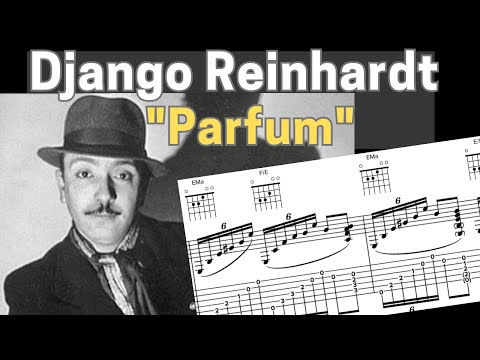
Tune details
Music: Django Reinhardt
Documented in archive: 1937
Original key: Not established
Study level: Advanced; arranged solo-guitar study
 Djangopedia
A solo-guitar miniature for hearing melody inside chords and controlling how long each voice rings.
Select two connected chord shapes.
Owner content reviewed — 2026-10-18T23:08:28Z by admin. Coverage measures presence, not accuracy. Content review does not certify rights or musical perfection.
Django recordings for this tune. Uploader dates and take labels remain source claims; only an evidenced exact association enables a row’s Listen control.
Django Reinhardt
source-described; accuracy not independently verified
Uploader identifies this as Django Reinhardt’s performance; recording date and take require comparison with the discography.
| Entry | Year | Recording / session / release evidence | Listen |
|---|---|---|---|
| 01 | 1937 | Parfum,OLA 1740-1,"Fremeaux FA 305, Affinity AFS 1003, Classics 748, Suisa JZCD 376, Mosaic MD6-190(6 CD Set).",27/4/37 - Paris - Django Reinhardt (g solo) | — |
A dash means no video has been associated with this exact historical recording. Tune-level listening resources remain available above.
Parlophone’s recording metadata identifies Reinhardt’s 1937 solo-guitar performance. Modern interpretations and a Gill & Jazz transcription provide complementary ways into its independent voices.
Music: Django Reinhardt
Documented in archive: 1937
Original key: Not established
Study level: Advanced; arranged solo-guitar study
A solo-guitar miniature for hearing melody inside chords and controlling how long each voice rings.
Parfum,OLA 1740-1,"Fremeaux FA 305, Affinity AFS 1003, Classics 748, Suisa JZCD 376, Mosaic MD6-190(6 CD Set).",27/4/37 - Paris - Django Reinhardt (g solo)
Follow the upper melody through the chord shapes instead of memorizing grips as isolated objects. Listen for notes that continue sounding while the bass moves.
A complete chord chart has not yet been verified. The exercises are editorial listening and practice suggestions, not a replacement score.
No readable chord chart has been added for this title.
No backing track has been added.
Performed studies, transcriptions, TAB, notation and lessons for studying Django’s solo. Inclusion does not certify note-for-note accuracy.
Gill & Jazz Transcriptions
Video available when checked; creator-described attribution.
Creator-presented transcription of Django’s solo. This is a study aid, not an independent certification of note-for-note accuracy.
If playback is unavailable, use the source link.
Follow a shared key, a harmonic idea or a familiar form. Keys refer to this site’s chart editions; other recordings may use a different key.
No sufficiently supported harmonic comparison has been added yet.
No match is established in the current chart metadata.
No match is established in the current chart metadata.
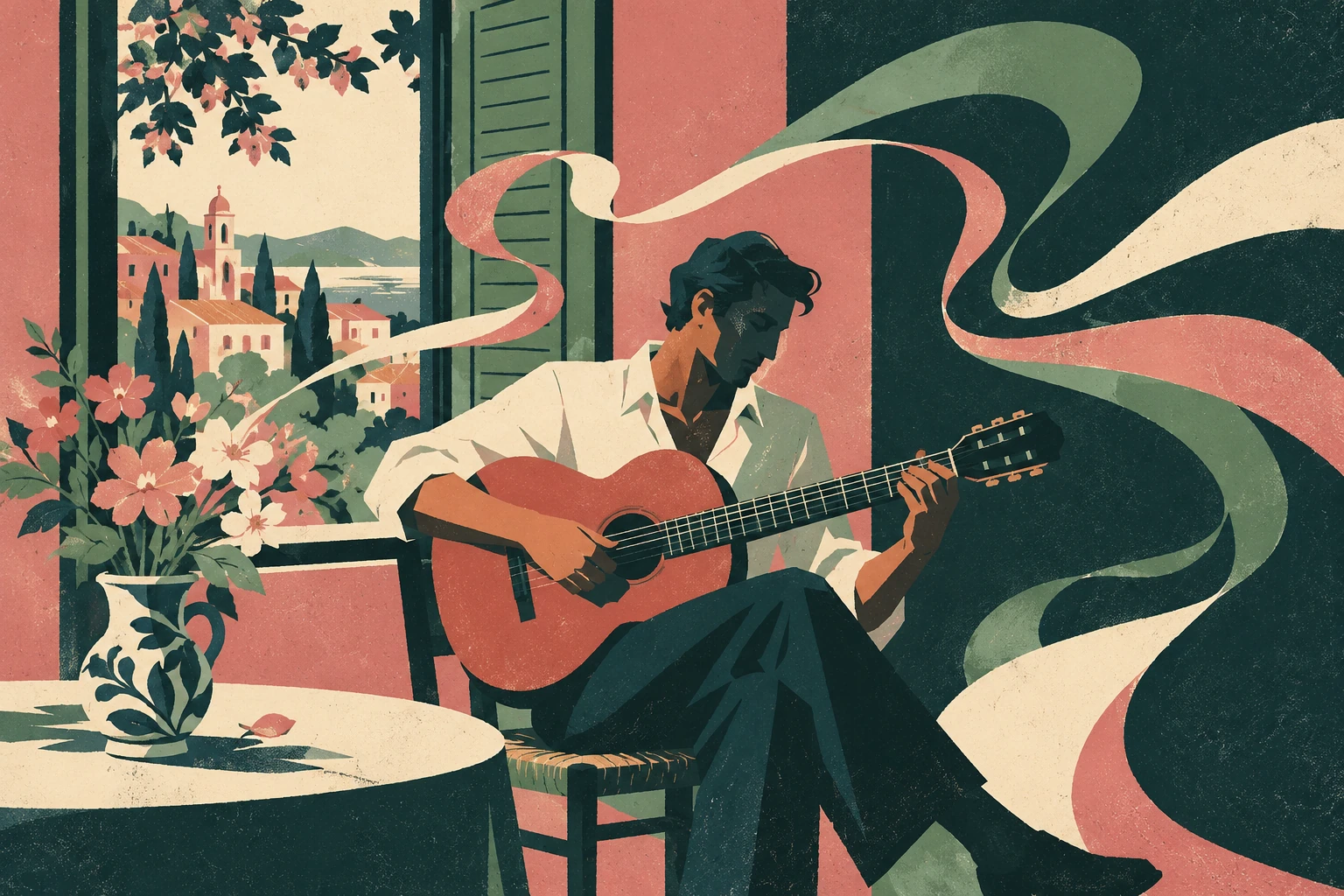
Original jazz serigraph illustration for parfum
Original AI-assisted editorial artwork inspired by the tune’s mood. It does not depict a documented historical event.
Original AI-generated illustration for Djangopedia; not a historical photograph.
Illustration credits & provenance →Selected performances by notable Gypsy Jazz players and ensembles. Inclusion is editorial and does not imply an objective popularity ranking.
Josh Turner Guitar
Video available when checked; creator-described attribution.
Performer attribution follows the video title and channel description. Proposed listening selection; no popularity ranking implied.
If playback is unavailable, use the source link.
 Parfum - Django Reinhardt CoverJosh Turner GuitarVideo available when checked; creator-described attribution.Performer attribution follows the video title and channel description. Proposed listening selection; no popularity ranking implied.✓ Featured
 Parfum - Django Reinhardttim robinsonVideo available when checked; creator-described attribution.Performer attribution follows the video title and channel description. Proposed listening selection; no popularity ranking implied.Select video
Select two connected chord shapes. Keep their common melody note ringing while changing only the bass, then restore the remaining voices.
A solo performance needs balance between bass and treble rather than a continuous rhythm-guitar strum. Keep low notes shorter if they mask the melody.
Slow phrase work; no fixed backing tempo prescribed
Select two connected chord shapes. Keep their common melody note ringing while changing only the bass, then restore the remaining voices.
Use a slow click to test one phrase internally, then remove it to shape the breath between phrases. Do not impose a fixed swing chorus on the full piece.
Solo-guitar arrangement: agree pacing and voice allocation before attempting a duo version.
The transcription is creator-supplied; difficult voicings may admit more than one fingering.
Keep the melody uppermost and begin with a single bass note under each harmony. A solo performance needs balance between bass and treble rather than a continuous rhythm-guitar strum. Keep low notes shorter if they mask the melody.
A solo performance needs balance between bass and treble rather than a continuous rhythm-guitar strum. Keep low notes shorter if they mask the melody.
No vocal arrangement is prescribed; use the instrumental melody as the phrasing reference.
This player guide combines inherited recording evidence and editorial study notes. Musical study notes are editorial suggestions; compare them with the recording.
Djangopedia full discography ↗
Credit / historical reference ↗
Inherited Djangopedia chart and recording evidence
Original AI-generated illustration for Djangopedia; not a historical photograph.
Original AI-assisted editorial artwork inspired by the tune’s mood. It does not depict a documented historical event.
Generated with the native image-generation tool on 2026-10-18; original editorial artwork, not a historical photograph.
Prompt: Original horizontal 1536x1024 3:2 editorial serigraph for jazz tune parfum. An anonymous guitarist beside an open window and vase of flowers, abstract scent-like curved ribbons floating through negative space. Use Stage 6C bold simplified angular silhouettes, asymmetrical negative space, flat limited inks dusty rose, sage, deep teal, ivory, handmade rough ink edges and tactile paper grain. Whimsical restrained mid-century jazz screen-print design. No gradients, no photorealism, no text/letters, no border. Original imagined scene, not a historical depiction. Heads and instruments fully inside frame.