
Tune details
Music: Django Reinhardt
Documented in archive: 1943
Original key: Not established
Study level: Intermediate harmony; advanced phrasing
 Djangopedia
A lyrical major-key piece in which repeated home-key phrases eventually open into a more searching final cadence. The understated beginning gives the later chromatic movement its expressive weight.
Learn why the second half ends differently from the first.
Owner content reviewed — 2026-10-05T18:28:14Z by admin. Coverage measures presence, not accuracy. Content review does not certify rights or musical perfection.
Django recordings for this tune. Uploader dates and take labels remain source claims; only an evidenced exact association enables a row’s Listen control.
Uploader identifies this as Django Reinhardt’s performance; recording date and take require comparison with the discography.
| Entry | Year | Recording / session / release evidence | Listen |
|---|---|---|---|
| 01 | 1943 | Manoir de mes Reves, 17/2/43, OSW 323-1 ,"Fremeaux FA 312, Classics 905, Jazz Time 790560-2, RDC 40032,( EMI 780671-2 has BL 114 from Jan/Feb 1949 marked as OSW 323-1 ), Mosaic MD6-190(6 CD Set)."," - Paris - Andre Lluis, Gerard Leveque (cl), Django Reinhardt (g), Eugene Vees (g), Jean Storne (b), Gaston Leonard (d)" | — |
| 02 | 1945 | Manoir de Mes Reves, 6/11/45, OSW 410-1,"Fremeaux FA 312, Classics 945, Blue Note 7243837138-2", - Paris - Django Reinhardt and his American Swing Band | — |
| 03 | 1947 | Manoir de mes Reves, 1947, "Fremeaux FA 313, ","Paris - Rendez-vous In Paris Radio Programme Django Reinhardt (g), Eddie Barnard (p)." | — |
| 04 | 1947 | Manoir de mes Reves, 8-13/11/47, "Fremeaux FA 315, Vogue 228E 6008, Kardum GLO 139"," - Paris - Souvenirs de Django Reinhardt - Django Reinhardt (elg), Gerard Leveque (cl), Eugene Vees (g), Emmanuel Soudieux (b), Andre Jourdan (d)" | — |
| 05 | 1947 | Manoir de mes Reves, Nov. 1947, "Fremeaux FA 316, Vogue 228E 6009, Vogue 600121", RTF Broadcast | — |
| 06 | 1949 | Manoir de mes Reves, Jan-Feb 1949, BL 114,"Fremeaux FA 317, BGO CD 198, Jazz Time 827447-2, EMI 746 5012, EMI 780671**"," - Rome - Django Reinhardt (g), Stephane Grappelly (v),Gianni Safred (p), Carlo Pecori (b), Aurelio de Carolis (d)." | — |
| 07 | 1949 | Manoir de mes Reves, 25/10/49, "Fremeaux FA 318, Vogue 228E 6010, Vogue 600121"," - Radio Geneve - Django Reinhardt (elg), Andre Ekyan (as,cl), Francois Vermeille (p), Jean Bouchety (b), Gaston Leonard (d)" | — |
| 08 | 1950 | Manoir de mes Reves, 1950, CW13,"Fremeaux FA 318, RCA ND 70929-2, Dejavu CD 32"," - Rome - Django Reinhardt (elg), Andre Ekyan (as,cl), Ralph Schecroun (p) Alf Masselier (b), Roger Paraboschi (d)" | — |
| 09 | 1951 | Manoir de mes Reves, 20/2/51, "Vogue 228E 6010, Vogue LP (NEC Plus Ultra 502008)", - Paris - Maurice Vander (p) replaces Raymond Fol | — |
| 10 | 1953 | Manoir de mes Reves, 10/3/53, Verve 835418-2," - Paris - Django Reinhardt (elg), Maurice Vander (p), Pierre Michelot(b), Jean-Louis Viale (d)" | — |
A dash means no video has been associated with this exact historical recording. Tune-level listening resources remain available above.
The legacy archive lists a 17 February 1943 recording and several later performances. It also flags a reissue on which a 1949 take was labelled as the 1943 matrix. This is a useful reminder to distinguish a release label from the underlying performance.
Music: Django Reinhardt
Documented in archive: 1943
Original key: Not established
Study level: Intermediate harmony; advanced phrasing
Listening task: Allow repeated phrases to grow in intensity without rushing. Count the head before comparing solo choruses.
Manoir de mes Reves, 17/2/43, OSW 323-1 ,"Fremeaux FA 312, Classics 905, Jazz Time 790560-2, RDC 40032,( EMI 780671-2 has BL 114 from Jan/Feb 1949 marked as OSW 323-1 ), Mosaic MD6-190(6 CD Set)."," - Paris - Andre Lluis, Gerard Leveque (cl), Django Reinhardt (g), Eugene Vees (g), Jean Storne (b), Gaston Leonard (d)"
Compare the tempo, key, introduction and final cadence with the first entry. Learn why the second half ends differently from the first.
Manoir de mes Reves, 10/3/53, Verve 835418-2," - Paris - Django Reinhardt (elg), Maurice Vander (p), Pierre Michelot(b), Jean-Louis Viale (d)"
Count its form and check its key before joining in. D-major statements lead toward G through Am–D7. E7 and B♭7 add unexpected colours before the return. The final half has a different closing route, including Fm–B♭7 into Em–A7.
D-major statements lead toward G through Am–D7. E7 and B♭7 add unexpected colours before the return. The final half has a different closing route, including Fm–B♭7 into Em–A7.
Chord symbols follow the inherited Djangopedia chart. Slashes are rhythmic marks; chord quality and turnaround choices may differ from the backing track. This is a chord reference, not a melody transcription.
[[Image:Manoir.gif]]


| D69/// | D/ A7(-9)/ | D/// | D/ A7(-9)/ | D/// | D/ A7(-9)/ | Am/// | D7/ D7(-9)/ |

| G69/// | G/ A7/ | D/// | D/ Bm/ | E7/// | E7/// | Bb7/// | Bb7/ A7(-9)/ |

| D69/// | D/ A7(-9)/ | D/// | D/ A7(-9)/ | D/// | D/ A7(-9)/ | Am/// | D7/ D7(-9)/ |

| G69/// | G69/// | E7/// | E7/// | Fm/ Bb7/ | Em/ A7/ | D/ Gm6 G#0 | D/// :||
Original source ↗
Guitare Improvisation · 5:55
Checked 2026-09-20
Highest displayed view count among matching backing-track videos returned by relevance and view-count YouTube searches. Not a complete platform-wide ranking.
Clément Reboul · 5:42
SerVa_Music · 2:37
Stephane Wrembel · 2:49
Performed studies, transcriptions, TAB, notation and lessons for studying Django’s solo. Resources are described by their creator; inclusion does not certify note-for-note accuracy.
Alex Farran Guitar · creator-described performance
The creator identifies a recreation of Django’s recorded solo. Compare it with the original; note-for-note accuracy remains to be reviewed.
Checked 2026-10-02
Follow a shared key, a harmonic idea or a familiar form. Keys refer to this site’s chart editions; other recordings may use a different key.
No sufficiently supported harmonic comparison has been added yet.
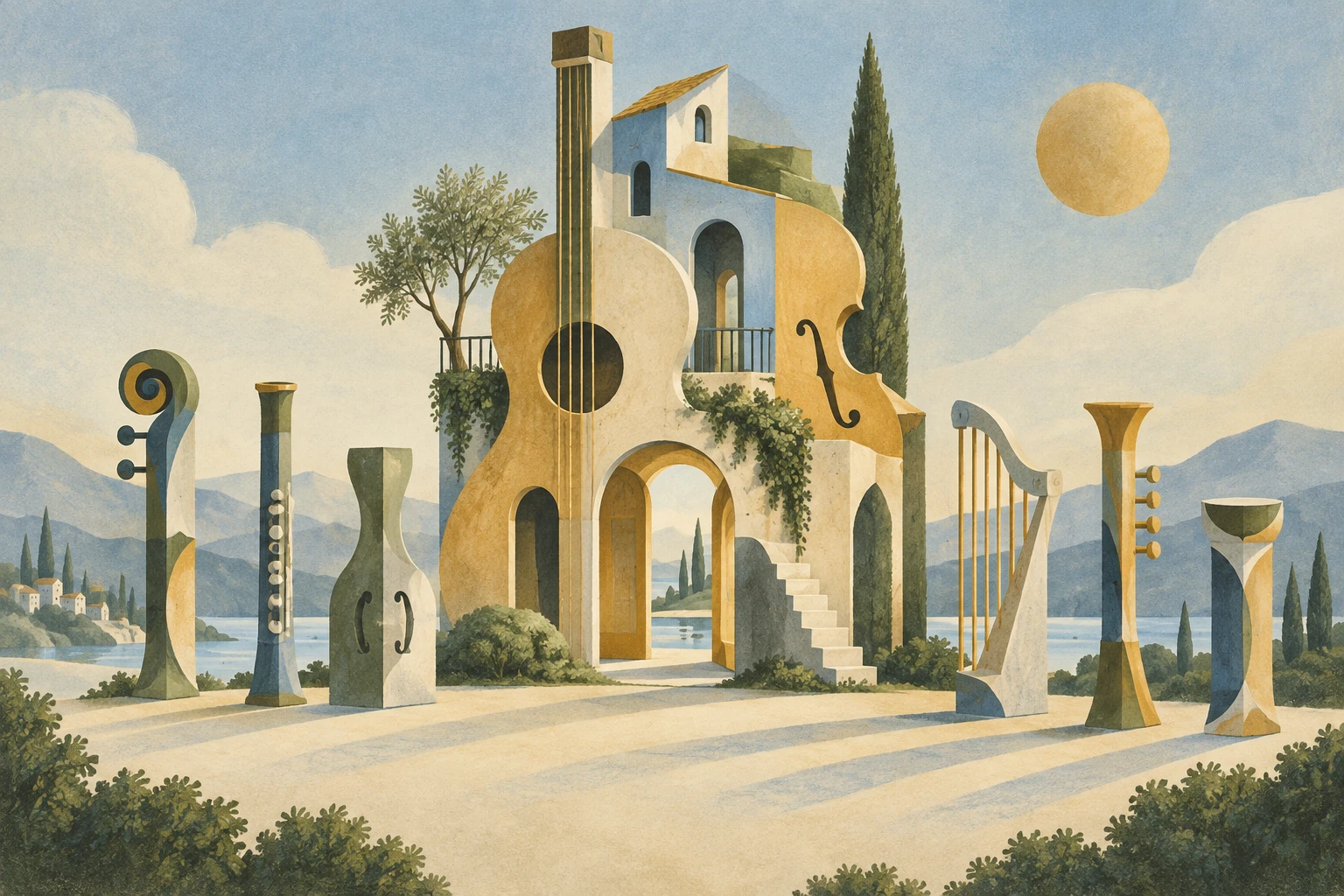
Django’s lyrical D-major ballad is documented from 1943, with later performances through 1953; the guide warns about a mislabelled reissue. The old photograph is a formal full ensemble standing with instruments.
An original editorial interpretation of the tune. This is an illustration, not an archival photograph or a documented reconstruction of a recording session.
Original Djangopedia illustration · AI-assisted, 2026
Illustration credits & provenance →Selected performances by notable Gypsy Jazz players and ensembles. Inclusion is editorial and does not imply an objective popularity ranking.
Romane and Stochelo Rosenberg · cminor7b5
2001 · Quebec City Jazz Festival, 2001
Year explicitly displayed in the video caption; independent festival interpretation.
If playback is unavailable, use the source link.
 Romane, Stochelo Rosenberg -- Manoir de mes revesRomane and Stochelo Rosenberg · cminor7b52001 · Quebec City Jazz Festival, 2001Year explicitly displayed in the video caption; independent festival interpretation.✓ Featured
 Manoir de mes rêves | Django Reinhardt | Lune de Jazz feat. Sébastien FélixLune de Jazz featuring Sébastien Félix · Lune de Jazz OfficielThéâtre de la Petite Rue, Villeurbanne; Studio Rockefeller audioWith Estéban Félix, Sydney Elancry, Stéphane Teyssier and Doménico Battaglia; contrasting vocal adaptation. Composition and lyric years are not performance years.Select performance
Sing the melody over a bass-only accompaniment. Next connect Fm–B♭7–Em–A7 with one continuous guide-tone line and rejoin the full form.
Use gentle sixth/ninth colours and avoid accenting every dominant as a dramatic event. Keep the melody prominent through the final chromatic approach.
Start at 65–80; explore 90–120 bpm
Sing the melody over a bass-only accompaniment. Next connect Fm–B♭7–Em–A7 with one continuous guide-tone line and rejoin the full form.
Start below the suggested tempo. First hear four quarter-note clicks, then halve the click rate and place clicks on beats 2 and 4. Keep the same phrase length.
Manoir de mes Reves — D major; 32 bars, two related 16-bar halves. Agree the tempo, pickup, solo order and ending before the count.
Ask the accompanist to support the long melody rather than supply continuous fills. Agree on a rubato ending before the performance.
A melody-led chord arrangement works well; retain one bass note per harmonic change and let inner voices move quietly.
Ask the accompanist to support the long melody rather than supply continuous fills. Agree on a rubato ending before the performance.
This guide studies an instrumental arrangement. Any later lyric adaptation requires its own credit and chosen key.
This player guide combines inherited recording evidence and editorial study notes. Musical study notes are editorial suggestions; compare them with the recording.
Guitare Improvisation — backing track ↗
Feature photograph — Gypsy Jazz UK historical archive ↗
Original Djangopedia illustration · AI-assisted, 2026
An original editorial interpretation of the tune. This is an illustration, not an archival photograph or a documented reconstruction of a recording session.
Generated with the native image-generation tool on 2026-10-08; original editorial artwork, not a historical photograph.
Prompt: Original editorial feature illustration for Manoir de mes Rêves. A softly textured lithographic dream image: an impossible but gentle house assembled from guitar contours, violin curves and open doorways floats above a calm cream landscape. Powder blue, moss green and restrained warm gold, airy asymmetry. This dream-house is an explicit musical/title metaphor, not Django’s real home or a historical location. Transform the old photo’s standing ensemble rhythm into a quiet row of abstract instrumental pillars. No human portrait, no fake archival patina. Original Djangopedia editorial illustration, clearly non-photographic. Do not copy a photograph, known artwork or specific artist. Landscape 1536 by 1024 feature image, important subjects within the middle 75% for responsive hero cropping. No lettering, numbers, musical notation glyphs, logos, signature, watermark, fake archival markings, caption or border. One finished candidate only.
Photograph rights are documented separately in its credit. They do not establish the rights status of the composition or recording.