
Tune details
Music: Irving Mills
Documented in archive: 1946
Original key: Not established
Study level: Intermediate listening work; advanced arrangement and source awareness
 Djangopedia
The reissue publisher uses Ride Red Ride and attributes the title to Irving Mills. The inherited Tiger Rag wording is preserved as a historical label, not promoted into a proven identity or composer equivalence. Listen to the amplified guitar’s entrance and the orchestra’s response as separate layers.
Learn one short guitar answer, then leave the full orchestral reply silent in your practice loop before playing it again.
Owner content reviewed — 2026-10-21T08:20:30Z by admin. Coverage measures presence, not accuracy. Content review does not certify rights or musical perfection.
Django recordings for this tune. Uploader dates and take labels remain source claims; only an evidenced exact association enables a row’s Listen control.
BD Music
Public, processed and embeddable when checked; creator-described identity.
Creator/distributor-supplied Django listening selection. No exact matrix/take association is asserted.
| Entry | Year | Recording / session / release evidence | Listen |
|---|---|---|---|
| 01 | 1946 | Improvisation on Tiger Rag (Ride Red Ride),"Fremeaux FA 313, Suisa JZCD 376, Vogue 228E 6005, RCA 74321 237692, Vogue 668003-1","10/11/46 - Chicago - Duke Ellington and his Orchestra featuring,Django Reinhardt (elg)" | — |
A dash means no video has been associated with this exact historical recording. Tune-level listening resources remain available above.
The reissue publisher uses Ride Red Ride and attributes the title to Irving Mills. The inherited Tiger Rag wording is preserved as a historical label, not promoted into a proven identity or composer equivalence.
Music: Irving Mills
Documented in archive: 1946
Original key: Not established
Study level: Intermediate listening work; advanced arrangement and source awareness
Listen to the amplified guitar’s entrance and the orchestra’s response as separate layers. Source-attributed credits: Source-attributed credit: Irving Mills. Roles follow the cited source; legal rights are not certified.
Establish the melody, bass arrivals and actual phrase length before assigning chord functions. Learn one short guitar answer, then leave the full orchestral reply silent in your practice loop before playing it again.
Inherited notation retained exactly. No new complete chart, concert key or take-specific transcription is certified.
No readable chord chart has been added for this title.
No backing track has been added.
Performed studies, transcriptions, TAB, notation and lessons for studying Django’s solo. Inclusion does not certify note-for-note accuracy.
No Django solo study aid yet. Know a useful resource — or want to record a study of this solo?
Follow a shared key, a harmonic idea or a familiar form. Keys refer to this site’s chart editions; other recordings may use a different key.
No sufficiently supported harmonic comparison has been added yet.
No match is established in the current chart metadata.
No match is established in the current chart metadata.
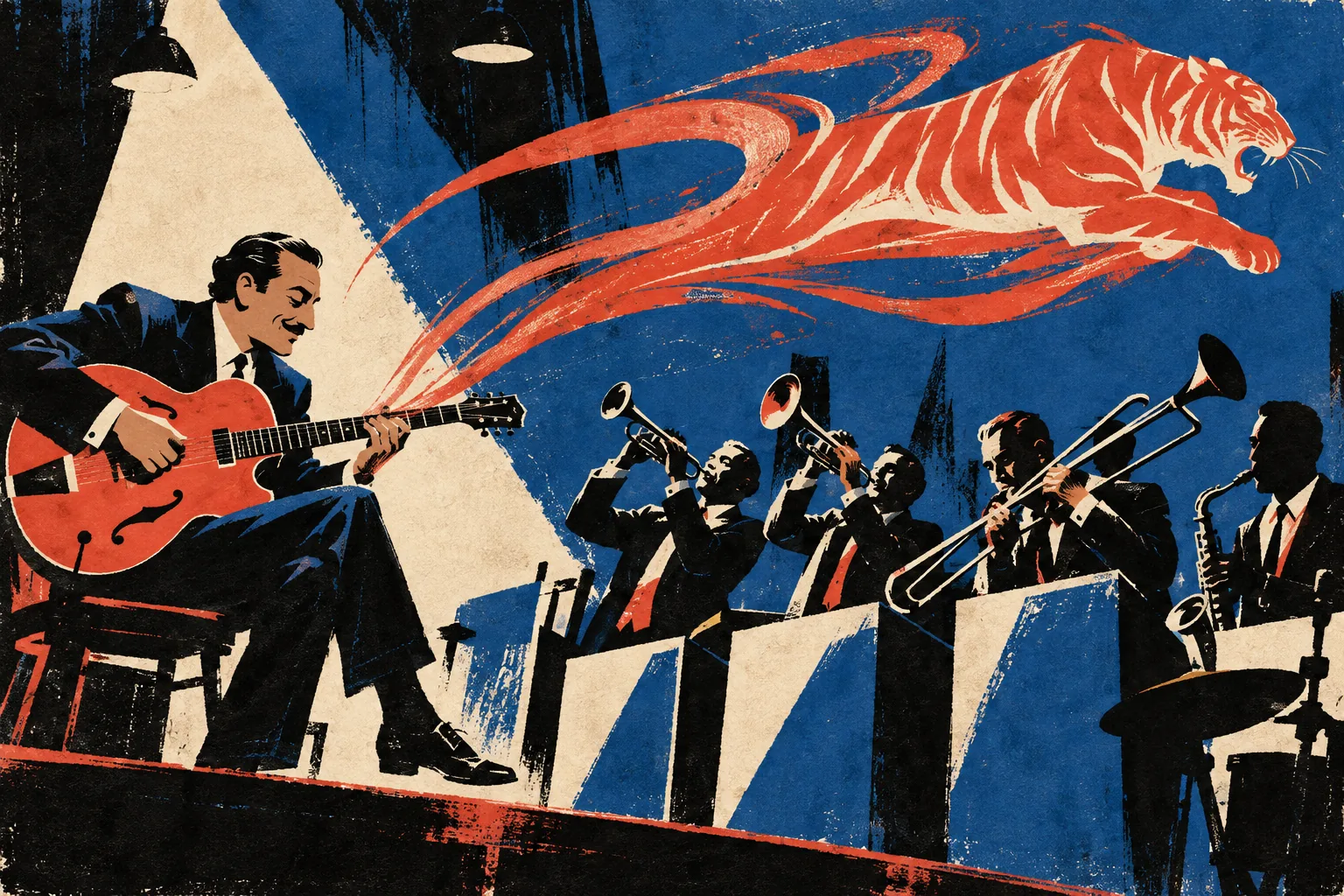
Owner-selected illustration. An electric guitarist launches a bright red ribbon that becomes a racing tiger-shaped silhouette above a small big-band brass section. Spirited improvised interplay inspired by the archival Tiger Rag/Ride Red title context, not a generic tiger portrait.
Original AI-assisted editorial artwork inspired by the tune; not a documented historical scene.
Original AI-assisted illustration created for Djangopedia
Illustration credits & provenance →Selected performances by notable Gypsy Jazz players and ensembles. Inclusion is editorial and does not imply an objective popularity ranking.
Notable Gypsy Jazz performances are being curated.
Learn one short guitar answer, then leave the full orchestral reply silent in your practice loop before playing it again.
Keep the rhythm part behind the orchestra; rehearse a two-bar cue and a clear cutoff instead of filling every gap.
Slow phrase practice, adjusted to the chosen source; no historical BPM asserted
Learn one short guitar answer, then leave the full orchestral reply silent in your practice loop before playing it again.
Use a quiet quarter-note click for short loops. Keep the preceding rest and the next entry in the loop; remove the click briefly to test internal time.
Confirm the composition identity, concert key and complete arrangement before calling the tune. Agree pickup and ending together.
The generic improvisation/Tiger Rag label does not establish exact work equivalence. Publisher attribution and the 1946 context are stated separately.
Begin with the melody alone, then add only independently established bass arrivals. Keep the rhythm part behind the orchestra; rehearse a two-bar cue and a clear cutoff instead of filling every gap.
Keep the rhythm part behind the orchestra; rehearse a two-bar cue and a clear cutoff instead of filling every gap.
Follow the song’s breathing where a vocal version exists. Establish the singer’s key independently; lyrics are not reproduced here.
This player guide combines inherited recording evidence and editorial study notes. Musical study notes are editorial suggestions; compare them with the recording.
Djangopedia full discography ↗
Reissue publisher booklet and discography ↗
Original AI-assisted illustration created for Djangopedia
Original AI-assisted editorial artwork inspired by the tune; not a documented historical scene.
Generated with the native image-generation tool on 2026-10-26; original editorial artwork, not a historical photograph.
Prompt: Use case: stylized-concept. Create one finished original landscape 1536x1024 (3:2) raster illustration for Djangopedia, tune Improvisation on Tiger Rag (Ride Red Ride). Tune context for interpretation only: The reissue publisher uses Ride Red Ride and attributes the title to Irving Mills. The inherited Tiger Rag wording is preserved as a historical label, not promoted into a proven identity or composer equivalence. Scene: An electric guitarist launches a bright red ribbon that becomes a racing tiger-shaped silhouette above a small big-band brass section. Spirited improvised interplay inspired by the archival Tiger Rag/Ride Red title context, not a generic tiger portrait. Art direction: Minimal mid-century musical still-life print: crisp hand-cut shapes, ingenious symbolic composition, uneven hand-pulled ink edges, very few carefully chosen details. Palette: ink black, cobalt blue, muted coral and ivory. Subtle dry ink and paper texture, controlled print misregistration. Make it an artwork with a memorable singular idea, readable as a thumbnail and rewarding at full size; vary viewpoint and composition. Constraints: entirely original composition, not a copy of an artist's print. No title, words, notation, logos or watermark. No photorealism, glossy 3D, gradients, airbrushed romantic haze, generic sunset or decorative hearts. If Django appears, swept-back dark hair, pencil moustache and a distinct mature individual face; period clothes, no ethnic stereotypes. Respect plausible instruments and hands, keep key subjects within frame. Use strong flat ink shapes rather than photorealistic rendering.