Tune details
Music: Django Reinhardt
Documented in archive: 1943
Original key: Not established
Study level: Intermediate listening work; advanced arrangement and source awareness
 Djangopedia
Improvisation No. 3 survives in two 1943 versions, OSW 329-1 and 329-2. The companion archive entry receives shared guide coverage without deleting its separate take identity. Follow the alternation between rolled chords and single-note movement, comparing equivalent gestures in both versions.
Isolate one chord-to-line transition.
Owner content reviewed — 2026-10-21T08:20:30Z by admin. Coverage measures presence, not accuracy. Content review does not certify rights or musical perfection.
Django recordings for this tune. Uploader dates and take labels remain source claims; only an evidenced exact association enables a row’s Listen control.
Django Reinhardt - Topic
Public, processed and embeddable when checked; creator-described identity.
Creator/distributor-supplied Django listening selection. No exact matrix/take association is asserted.
| Entry | Year | Recording / session / release evidence | Listen |
|---|---|---|---|
| 01 | 1943 | Improvisation No.3 Pt.I,OSW 329-1,"Fremeaux FA 312, Classics 905, Jazz Time 789952-2, RDC 40032, RCA 74321 237692, Mosaic MD6-190(6 CD Set).",26/2/43 - Django Reinhardt (g solo) | — |
A dash means no video has been associated with this exact historical recording. Tune-level listening resources remain available above.
Improvisation No. 3 survives in two 1943 versions, OSW 329-1 and 329-2. The companion archive entry receives shared guide coverage without deleting its separate take identity.
Music: Django Reinhardt
Documented in archive: 1943
Original key: Not established
Study level: Intermediate listening work; advanced arrangement and source awareness
Follow the alternation between rolled chords and single-note movement, comparing equivalent gestures in both versions. Source-attributed credits: Source-attributed credit: Django Reinhardt. Roles follow the cited source; legal rights are not certified.
Establish the melody, bass arrivals and actual phrase length before assigning chord functions. Isolate one chord-to-line transition. Hold the destination shape silently, sound the bass, then release into the line without accelerating.
Inherited notation retained exactly. No new complete chart, concert key or take-specific transcription is certified.
No readable chord chart has been added for this title.
No backing track has been added.
Performed studies, transcriptions, TAB, notation and lessons for studying Django’s solo. Inclusion does not certify note-for-note accuracy.
DjangoKOR
Public, processed and embeddable when checked; creator-described identity.
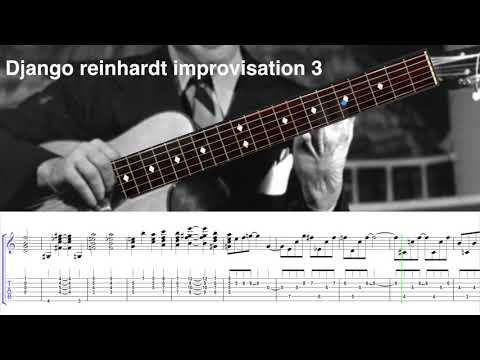
DjangoKOR score-following notation/TAB with an animated fretboard, visually checked during playback. A virtual study of the solo, not a filmed human recreation; transcription accuracy remains for musical review.
If playback is unavailable, use the source link.
Follow a shared key, a harmonic idea or a familiar form. Keys refer to this site’s chart editions; other recordings may use a different key.
No sufficiently supported harmonic comparison has been added yet.
No match is established in the current chart metadata.
No match is established in the current chart metadata.
This image is an editorial illustration; a connection to this recording has not been established.
Original AI-assisted editorial artwork inspired by the tune’s mood; not a documented historical scene.
Original AI-assisted illustration created for Djangopedia
Illustration credits & provenance →Selected performances by notable Gypsy Jazz players and ensembles. Inclusion is editorial and does not imply an objective popularity ranking.
Notable Gypsy Jazz performances are being curated.
Isolate one chord-to-line transition. Hold the destination shape silently, sound the bass, then release into the line without accelerating.
For solo guitar, balance bass, inner voices and melody independently. In a duo arrangement agree where the accompanist should remain silent.
Slow phrase practice, adjusted to the chosen source; no historical BPM asserted
Isolate one chord-to-line transition. Hold the destination shape silently, sound the bass, then release into the line without accelerating.
Use a quiet quarter-note click for short loops. Keep the preceding rest and the next entry in the loop; remove the click briefly to test internal time.
Gilles Rea’s virtual guitar transcription of take 1. Additional score-following study; no new recording_ref association.
Confirm the composition identity, concert key and complete arrangement before calling the tune. Agree pickup and ending together.
Part I/II is an inherited naming convention, not proof of one continuous performance. Do not force a regular chorus onto an unverified solo form.
Begin with the melody alone, then add only independently established bass arrivals. For solo guitar, balance bass, inner voices and melody independently. In a duo arrangement agree where the accompanist should remain silent.
For solo guitar, balance bass, inner voices and melody independently. In a duo arrangement agree where the accompanist should remain silent.
Follow the song’s breathing where a vocal version exists. Establish the singer’s key independently; lyrics are not reproduced here.
This player guide combines inherited recording evidence and editorial study notes. Musical study notes are editorial suggestions; compare them with the recording.
Djangopedia full discography ↗
Reissue publisher booklet and discography ↗
Transcriber: six improvisations and alternate takes ↗
Original AI-assisted illustration created for Djangopedia
Original AI-assisted editorial artwork inspired by the tune’s mood; not a documented historical scene.
Generated with the native image-generation tool on 2026-10-21; original editorial artwork, not a historical photograph.
Prompt: Use case: stylized-concept. Asset: one original Djangopedia tune illustration, landscape 1536x1024, 3:2. Title context only, do not write words: Improvisation No. 3 — two versions. Scene: A lone mature guitarist balances a bass note and a rolled chord, seated on a sharply angled stool, with two overlapping flat shadow shapes. Strong confident hands, practical suit, no written notation. Style: witty 1950s cartoon serigraph, dry graphic and unsentimental. Confident chunky contours, flat separate ink shapes, mildly exaggerated expressive adult faces and hands, humorous posture, strong asymmetric composition. Limited palette: aubergine, mustard, charcoal and warm cream. Slight screen-print misregistration and occasional dry ink texture, generous clean paper. No gradients or glossy shading. Django-like guitarist where present: documented swept-back dark hair and thin pencil moustache, individual mature face. Supporting adults are distinct individuals in historically informed 1930s–1940s jazz-circle clothing. No ethnic caricatures or stereotypes. Keep heads, hands and instrument bodies within the frame, plausible instrument anatomy. No text, letters, numerals, notation, logos, watermark, border, photorealism, dreamy sunset, hearts or romantic haze. Imagined editorial scene, not a documented event. Entirely original composition, no reproduction of an existing artist’s print.