
Tune details
Music: Django Reinhardt
Documented in archive: 1943
Original key: Not established
Study level: Intermediate listening study; advanced source and arrangement awareness
 Djangopedia
Gaiement is documented in the July 1943 orchestral repertoire; the existing archive title Gaiment is retained with the publisher spelling noted. Follow the melody through the larger ensemble and notice where the guitar adds articulation rather than volume.
Choose one articulated figure and practise it softly with a metronome, preserving both its accents and rests.
Owner content reviewed — 2026-10-21T01:13:20Z by admin. Coverage measures presence, not accuracy. Content review does not certify rights or musical perfection.
Django recordings for this tune. Uploader dates and take labels remain source claims; only an evidenced exact association enables a row’s Listen control.
Django Reinhardt - Topic
Public, processed and embeddable when checked; creator-described identity.
Creator/distributor-supplied Django listening selection. No exact matrix/take association is asserted.
| Entry | Year | Recording / session / release evidence | Listen |
|---|---|---|---|
| 01 | 1943 | Gaiment,OSW 356-1 ,"Fremeaux FA 312, Classics 905, Jazz Time 799991-2, HEP 1041",7/7/43 - Paris - Django Reinhardt et Son Orchestre | — |
A dash means no video has been associated with this exact historical recording. Tune-level listening resources remain available above.
Gaiement is documented in the July 1943 orchestral repertoire; the existing archive title Gaiment is retained with the publisher spelling noted.
Music: Django Reinhardt
Documented in archive: 1943
Original key: Not established
Study level: Intermediate listening study; advanced source and arrangement awareness
Follow the melody through the larger ensemble and notice where the guitar adds articulation rather than volume. Source-attributed credits: Django Reinhardt in the publisher list under Gaiement.
Establish the actual melody and harmonic arrivals before choosing substitutions. Choose one articulated figure and practise it softly with a metronome, preserving both its accents and rests.
No verified complete chart or concert key is supplied. Any inherited raw notation is retained without silently repairing it.
No readable chord chart has been added for this title.
No backing track has been added.
Performed studies, transcriptions, TAB, notation and lessons for studying Django’s solo. Inclusion does not certify note-for-note accuracy.
No Django solo study aid yet. Know a useful resource — or want to record a study of this solo?
Follow a shared key, a harmonic idea or a familiar form. Keys refer to this site’s chart editions; other recordings may use a different key.
No sufficiently supported harmonic comparison has been added yet.
No match is established in the current chart metadata.
No match is established in the current chart metadata.
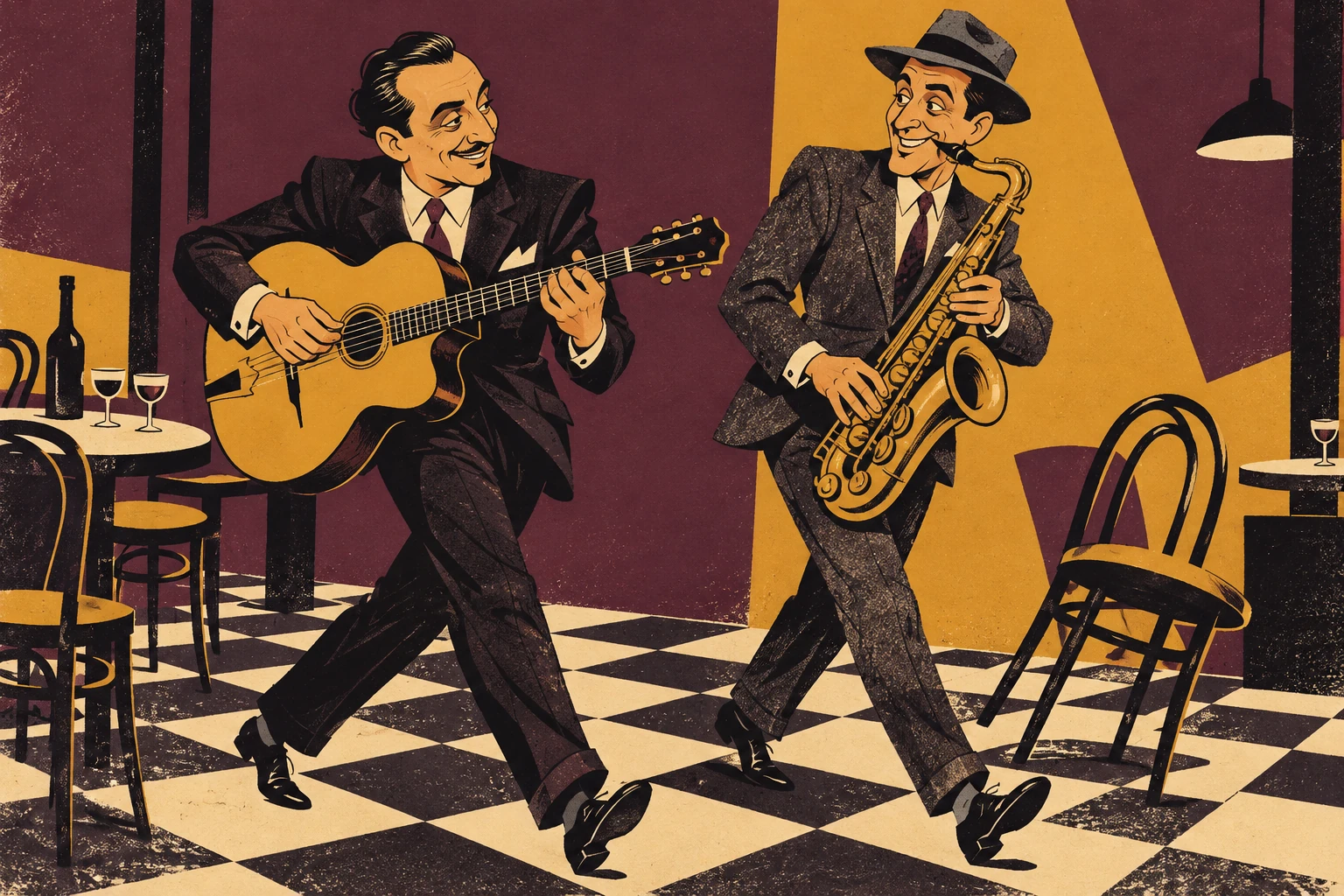
This image is an editorial illustration; a connection to this recording has not been established.
Original AI-assisted editorial artwork inspired by the tune’s mood; not a documented historical scene.
Original AI-assisted illustration created for Djangopedia
Illustration credits & provenance →Selected performances by notable Gypsy Jazz players and ensembles. Inclusion is editorial and does not imply an objective popularity ranking.
Notable Gypsy Jazz performances are being curated.
Choose one articulated figure and practise it softly with a metronome, preserving both its accents and rests.
Keep a light, consistent chord pulse, reserving a stronger accent for an entrance actually supported by the recording.
Begin short phrase work around 60–90 quarter-note BPM; adapt to the verified source
Choose one articulated figure and practise it softly with a metronome, preserving both its accents and rests.
Use a quiet quarter-note click for short loops. Keep the preceding rest and the next entry in the loop; remove the click briefly to test internal time.
Confirm the composition identity, concert key and complete arrangement before calling the tune. Agree pickup and ending together.
Neither the upbeat title nor a remaster's metadata establishes the original tempo or a complete chord form.
Begin with the melody alone, then add only independently established bass arrivals. Keep a light, consistent chord pulse, reserving a stronger accent for an entrance actually supported by the recording.
Keep a light, consistent chord pulse, reserving a stronger accent for an entrance actually supported by the recording.
Follow the song’s breathing where a vocal version exists. Establish the singer’s key independently; lyrics are not reproduced here.
This player guide combines inherited recording evidence and editorial study notes. Musical study notes are editorial suggestions; compare them with the recording.
Djangopedia full discography ↗
Reissue publisher booklet and discography ↗
Original AI-assisted illustration created for Djangopedia
Original AI-assisted editorial artwork inspired by the tune’s mood; not a documented historical scene.
Generated with the native image-generation tool on 2026-10-21; original editorial artwork, not a historical photograph.
Prompt: Use case: stylized-concept. Asset: one original Djangopedia tune illustration, landscape 1536x1024, 3:2. Title context, do not write any words: Gaiment. Scene: A Django-like guitarist and a saxophonist step briskly across a checkerboard cafe floor, grinning at one another. A small tilted chair adds visual wit; buoyant dry graphic movement, no sentimental scenery. Style: witty 1950s cartoon serigraph. Confident chunky contours; simplified flat separate ink shapes; lively mildly exaggerated adult head/hand proportions, humorous posture, strong asymmetric composition. Dry, graphic and unsentimental. Limited palette: aubergine, mustard, charcoal and warm cream. Controlled screen-print misregistration, occasional dry ink texture and generous clean paper; no gradients or glossy digital shading. Faces: Django-like guitarist uses documented swept-back dark hair, small pencil moustache and expressive mature face; early guitar-banjo scenes use a younger adult. Supporting musicians are distinct individuals in historically informed 1920s–1940s Paris jazz-circle clothing. No ethnic caricature, racial stereotypes or costumes. Faces, instrument bodies and hands remain within frame, with convincing basic instrument anatomy. No text, letters, numerals, notation, logos, watermark, decorative border, photorealism, dreamy sunset, hearts or romantic haze. Imagined editorial scene, not a documented event. Entirely original composition; do not reproduce any artist's existing print.