
Tune details
Music: Con Conrad, J. Russel Robinson
Words: Benny Davis
Published / composed / adapted — see history: 1920
Original key: Not established
Study level: Intermediate; advanced where the inherited roadmap needs reconstruction
 Djangopedia
An open, direct song that gives the rhythm section room to swing. Long tonic and subdominant stretches make melodic development more useful than constant substitutions.
Make a simple motif carry the long chord areas.
Owner content reviewed — 2026-10-06T18:39:07Z by admin. Coverage measures presence, not accuracy. Content review does not certify rights or musical perfection.
Django recordings for this tune. Uploader dates and take labels remain source claims; only an evidenced exact association enables a row’s Listen control.
Uploader identifies this as Django Reinhardt’s performance; recording date and take require comparison with the discography.
| Entry | Year | Recording / session / release evidence | Listen |
|---|---|---|---|
| 01 | 1940 | Margie, 22/2/40, OSW 117-1 ,"Fremeaux FA 310, Classics 831"," - Paris - Andre Ekyan(as),Django & Joseph Reinhardt(g),Emmanuel Soudieux(b)" | — |
| 02 | 1940 | Margie, 22/10/40, OSW 141-1,"Fremeaux FA 310, Classics 831", - Paris - Noel Chiboust et Son Orchestre featuring Django Reinhardt (g) | — |
| 03 | 1951 | Margie, 10/2/51, "Vogue 228E 6010, Vogue LP (NEC Plus Ultra 502008)"," - Paris - Django Reinhardt (g), Bernard Hullin (tpt), Hubert Fol (as), Raymond Fol (p), Pierre Michelot (b), Pierre Lemarchand (d)" | — |
A dash means no video has been associated with this exact historical recording. Tune-level listening resources remain available above.
Margie is credited here to Con Conrad, J. Russel Robinson. The source date is 1920; publication, composition and later lyric adaptations may have separate dates. The inherited archive lists 3 recording entries, with dated entries spanning 1940–1951. These are archive rows, not a claim that every entry is a distinct released take. The linked recording rows preserve the original discographical wording. Compare their dates, matrices and personnel when choosing a performance to study.
Music: Con Conrad, J. Russel Robinson
Words: Benny Davis
Published / composed / adapted — see history: 1920
Original key: Not established
Study level: Intermediate; advanced where the inherited roadmap needs reconstruction
Listening task: Keep the main melodic statement clear and singable even at a lively tempo. Mark the key, pickup, phrase lengths and ending before comparing another version.
Margie, 22/2/40, OSW 117-1 ,"Fremeaux FA 310, Classics 831"," - Paris - Andre Ekyan(as),Django & Joseph Reinhardt(g),Emmanuel Soudieux(b)"
Compare the first and last listed entries for tempo, instrumentation and arrangement. Do not infer identical takes from a shared title. Make a simple motif carry the long chord areas.
Margie, 10/2/51, "Vogue 228E 6010, Vogue LP (NEC Plus Ultra 502008)"," - Paris - Django Reinhardt (g), Bernard Hullin (tpt), Hubert Fol (as), Raymond Fol (p), Pierre Michelot (b), Pierre Lemarchand (d)"
The selected backing track is labelled F; this inherited chart is in E♭. Transpose the whole chart up a tone or use a matching E♭ arrangement.
E♭ moves through E♭7 to A♭. C7–F7–B♭7 prepares the return, while the second half has its own G7 colour and final cadence.
Chord symbols and source cell divisions are preserved from Djangopedia. Slashes mark rhythm; 0 is inherited diminished notation whose exact voicing should be checked against the melody. This is a chord reference, not a melody transcription.
| Eb/// | Eb/// | Eb/// | Eb7/// | Ab/// | Ab/// | Ab/// | Ab/// |

| Eb/// | Eb/// | C7/// | C7/// | F7/// | F7/// | Bb7/// | Bb7/// |

| Eb/// | Eb/// | Eb/// | Eb7/// | Ab/// | Ab/// | G7/// | G7/// |

| Eb/// | Eb/// | Eb/// | C7/// | Fm7/// | Bb7/// | Eb/ E0/ | Fm7/ Bb7/ :||
Original source ↗
Jazzing · The selected backing track is labelled F; this inherited chart is in E♭. Transpose the whole chart up a tone or use a matching E♭ arrangement. · 3:41
Checked 2026-10-01
Most-viewed suitable match selected from the captured search results after title/composition review; not a complete YouTube ranking. Source counts were captured on 1 October 2026. Coaching, unrelated songs and non-backing performances are excluded.
Performed studies, transcriptions, TAB, notation and lessons for studying Django’s solo. Resources are described by their creator; inclusion does not certify note-for-note accuracy.
Guitareal Jazz Transcriptions · Owner-approved study selection. YouTube identity and player availability checked 6 October 2026; musical accuracy and exact take not independently certified.
Owner selected 6 October 2026. Django transcription/TAB study; a new played recreation is not demonstrated.
Follow a shared key, a harmonic idea or a familiar form. Keys refer to this site’s chart editions; other recordings may use a different key.
No sufficiently supported harmonic comparison has been added yet.
No match is established in the current chart metadata.
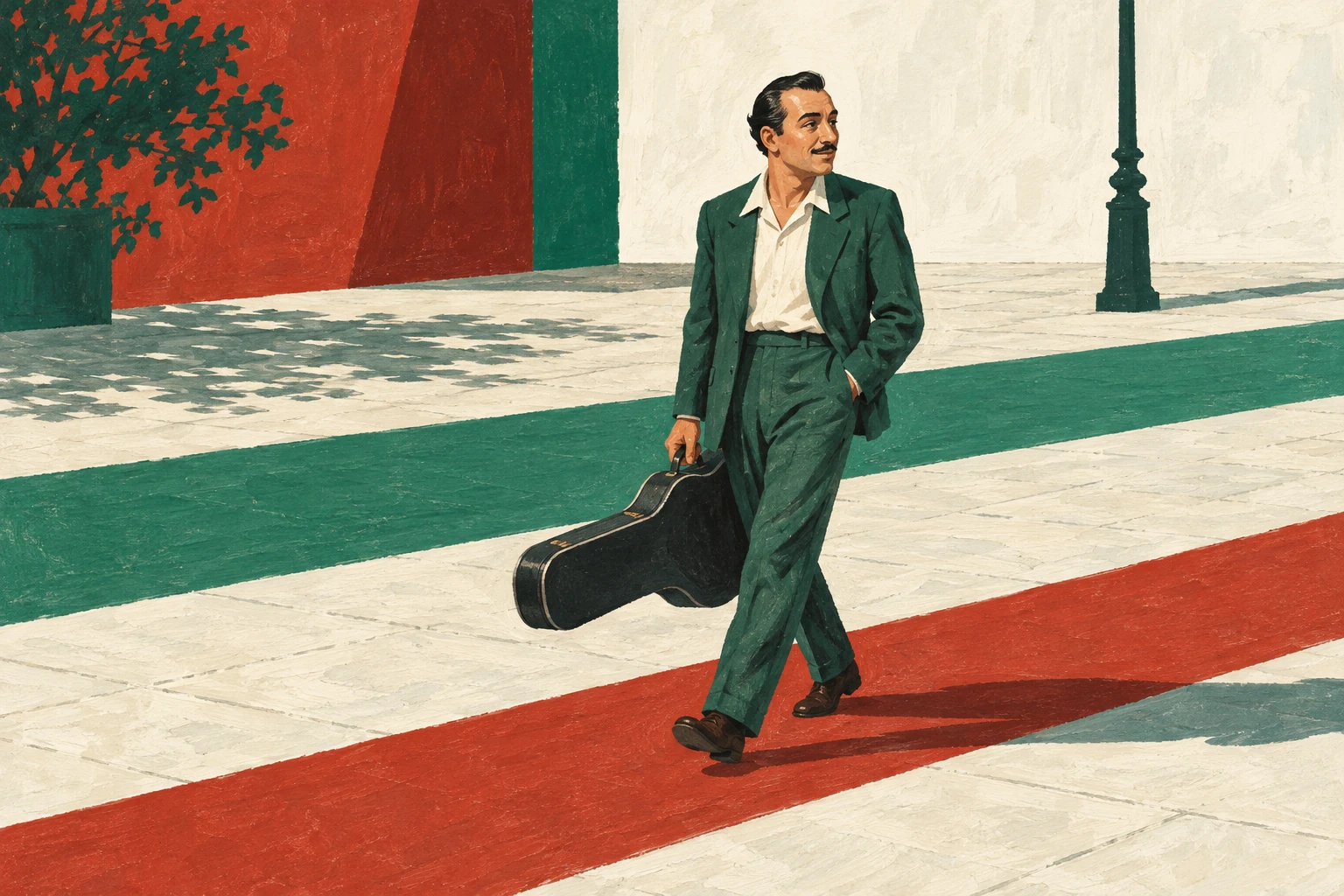
A small standing Django walks casually carrying a closed guitar case across a wide open daylight square; two long coloured bands support a small recurring gesture. The simple motif over long tonic stretches feels sociable and unforced, without a biographical meeting.
An original editorial interpretation of the tune. This is an illustration, not an archival photograph or a documented reconstruction of a recording session.
Original Djangopedia illustration · AI-assisted, 2026
Illustration credits & provenance →Selected performances by notable Gypsy Jazz players and ensembles. Inclusion is editorial and does not imply an objective popularity ranking.
Rosenberg Trio · Pegasus Grane
Recorded trio performance
Stage 4N private performance. Independent Rosenberg interpretation; uploader describes a late-1940s Django sound. No complete performed study of Django’s solo established.
If playback is unavailable, use the source link.
 Margie - Rosenberg TrioRosenberg Trio · Pegasus GraneRecorded trio performanceStage 4N private performance. Independent Rosenberg interpretation; uploader describes a late-1940s Django sound. No complete performed study of Django’s solo established.✓ Featured
 Russell Welch Quintet +1 "Margie"Russell Welch Hot Jazz Quintet with Chloe Feoranzo · Conrad Cayman Music2016 · Spotted Cat, New Orleans, 5 April 2016Stage 4N private performance. Hot-jazz ensemble contrast, with violin, accordion and clarinet.Select performance
 Gypsy Jazz Guitar - Margie - Johnny Ligthart TrioJohnny Ligthart Trio · Johnny LigthartLive acoustic trio, one takeStage 4N private performance. Artist describes two microphones and no overdubs.Select performance
 Cabaret Boreale - Margie - Rare old footage of CB's only performance of this song.Cabaret Boreale with Andrew Brown · Cabaret Boreale2023 · Tangent Gallery, Detroit, 30 June 2023Stage 4N private performance. Vocal, accordion, guitar and tuba contrast.Select performance
Play a two-note motif across the long E♭ and A♭ passages. Change only its final note when the harmony moves, then leave one full bar of silence.
Let the four-bar A♭ area breathe. Use dynamic shape across the phrase instead of adding a passing chord on every beat.
Start around 100–140 bpm; increase only after the form stays secure
Play a two-note motif across the long E♭ and A♭ passages. Change only its final note when the harmony moves, then leave one full bar of silence.
Begin with four quarter-note clicks. Halve the click rate and hear beats 2 and 4 while maintaining the same phrase lengths.
Margie — E♭ major; 32 printed bars, two related halves. Agree the pickup, tempo and ending before counting in.
32 printed bars, two related halves. Keep the head and solo chorus lengths explicit at the count-in.
Start with melody and bass only. Add the following colour without interrupting the melody: Lower D to D♭ as E♭ becomes E♭7.
Let the four-bar A♭ area breathe. Use dynamic shape across the phrase instead of adding a passing chord on every beat. Agree the full roadmap and signal the last head before it starts.
Choose a comfortable vocal key and transpose the whole arrangement, including its introduction and ending.
This player guide combines inherited recording evidence and editorial study notes. Musical study notes are editorial suggestions; compare them with the recording.
Djangopedia — inherited chart and recording rows ↗
Composition credits and background ↗
Feature photograph — source collection ↗
Original Djangopedia illustration · AI-assisted, 2026
An original editorial interpretation of the tune. This is an illustration, not an archival photograph or a documented reconstruction of a recording session.
Generated with the native image-generation tool on 2026-10-08; original editorial artwork, not a historical photograph.
Prompt: Use case: illustration-story. One original editorial feature illustration for Djangopedia's guide “Margie”. Landscape 1536 × 1024, opaque background. Scene: A small standing Django walks casually carrying a closed guitar case across a wide open daylight square; two long coloured bands support a small recurring gesture. The simple motif over long tonic stretches feels sociable and unforced, without a biographical meeting. Musical basis from the guide: An open, direct song that gives the rhythm section room to swing. Long tonic and subdominant stretches make melodic development more useful than constant substitutions. The supplied chart is E♭ major; form: 32 printed bars, two related halves; feel: Swing. These describe musical inspiration, not visible writing. Historical context: Margie is credited here to Con Conrad, J. Russel Robinson. The source date is 1920; publication, composition and later lyric adaptations may have separate dates. Do not illustrate disputed historical claims or suggest this imagined scene is an archival session. Medium: mid-century editorial. Dominant palette: jade brick red and clean white. Composition: walking figure beside wide rhythm. Human presence: one small Django figure. Strong intentional design, clearly drawn/painted, distinctive material marks; keep essential subject safely within the central 70 percent width and middle 80 percent height for card crops. Maintain enough visual substance at thumbnail size. Broad inspiration observed in old photo, ONLY scale/rhythm and never a reference image: two standing figures; tall vertical portrait; light-dark pairing. Independently invent every pose, perspective, clothing, setting and lighting. Avoid: No handshake, Louis Armstrong likeness, centered hero portrait. No photorealism, archival simulation, generated text, letters, numbers, labels, fake musical notation, logo, signature, watermark, fake dates, yellowed-paper patina, recognizable artwork or copied photograph. No imitation of any named artist. Render the art edge to edge without borders, mockup or typography. Batch A diversity compensation: avoid blue sky, drifting clouds, cypress trees, moon discs, generic Paris landmarks and curving terrace backdrops unless explicitly essential to the stated scene. Keep this composition tied to its precise stated subject; do not add an unrequested landscape or city. For figure scenes keep the specified standing/walking pose; no seated centered guitar portrait. For abstracts keep purely graphic materials and forms.
Photograph provenance and rights are stated separately. Attribution does not establish permission.