
Tune details
Music: Vincent Rose, Al Jolson (credited co-writer)
Words: Buddy DeSylva
Published / composed: 1920
Original key: Not established
Study level: Intermediate harmony; advanced at fast tempos
 Djangopedia
A lively standard whose opening waits on the dominant before releasing into the tonic. Long harmonic spans reward rhythmic invention; the contrasting later phrases need a clear sense of direction.
Let the long dominant create expectation before the tonic answer.
Owner content reviewed — 2026-10-04T11:50:35Z by admin. Coverage measures presence, not accuracy. Content review does not certify rights or musical perfection.
Django recordings for this tune. Uploader dates and take labels remain source claims; only an evidenced exact association enables a row’s Listen control.
Uploader identifies this as Django Reinhardt’s performance; recording date and take require comparison with the discography.
| Entry | Year | Recording / session / release evidence | Listen |
|---|---|---|---|
| 01 | 1935 | Avalon, 2/3/35, OLA 347-1 ,"Fremeaux FA 302, JSP 344, Conifer CDHD 230, EMI JazzTime 251277-2"," - Paris - Coleman Hawkins (ts), Michel Warlop & Orchestra featuring Django Reinhardt (g)." | — |
| 02 | 1935 | Avalon, July 1935, P 77434 ,"Fremeaux FA 303, Classics 727, JSP 341, Vogue 668003-1, Conifer HD 165"," - QHCF+ - Arthur Briggs, Alphonse Cox, Pierre Allier (tpt), Eugene d'Hellemes (tbn), Stephane Grappelly (v), Django Reinhardt (g), Joseph Reinhardt, Roger Chaput (g), Louis Vola (b)." | — |
A dash means no video has been associated with this exact historical recording. Tune-level listening resources remain available above.
Avalon was published in 1920 with credits associated with Vincent Rose, Al Jolson and Buddy DeSylva. Djangopedia’s first listed Django session is 2 March 1935 with Coleman Hawkins and Michel Warlop’s orchestra. It is the early jazz standard, not the later Roxy Music song.
Music: Vincent Rose, Al Jolson (credited co-writer)
Words: Buddy DeSylva
Published / composed: 1920
Original key: Not established
Study level: Intermediate harmony; advanced at fast tempos
Listening task: Place the melody’s pickup before increasing tempo. Count the head before comparing solo choruses.
Avalon, 2/3/35, OLA 347-1 ,"Fremeaux FA 302, JSP 344, Conifer CDHD 230, EMI JazzTime 251277-2"," - Paris - Coleman Hawkins (ts), Michel Warlop & Orchestra featuring Django Reinhardt (g)."
Compare the tempo, key, introduction and final cadence with the first entry. Let the long dominant create expectation before the tonic answer.
Avalon, July 1935, P 77434 ,"Fremeaux FA 303, Classics 727, JSP 341, Vogue 668003-1, Conifer HD 165"," - QHCF+ - Arthur Briggs, Alphonse Cox, Pierre Allier (tpt), Eugene d'Hellemes (tbn), Stephane Grappelly (v), Django Reinhardt (g), Joseph Reinhardt, Roger Chaput (g), Louis Vola (b)."
Count its form and check its key before joining in. C7 opens the first two phrases before F answers. D7 then leads toward G minor; B♭ minor supplies a darker colour before the final return through Gm–C7–F.
C7 opens the first two phrases before F answers. D7 then leads toward G minor; B♭ minor supplies a darker colour before the final return through Gm–C7–F.
Chord symbols follow the inherited Djangopedia chart. Slashes are rhythmic marks; chord quality and turnaround choices may differ from the backing track. This is a chord reference, not a melody transcription.
[[Image:Avalon.gif]]


| C7/// | C7/// | C7/// | C7/// | F/// | F/ C7/ | F/// | F/// |

| C7/// | C7/// | C7/// | C7/// | F/// | F/ C7/ | F/// | F/// |

| D7/// | A0/// | D7/// | D7/// | Gm/// | Gm/// | Bbm/// | Bbm/ B0/ |

| F/// | F/// | D7/// | D7/// | Gm/// | C7/// | F/// | F/// :||
Original source ↗
Guitare Improvisation · 5:32
Checked 2026-09-20
Highest displayed view count among matching backing-track videos returned by relevance and view-count YouTube searches. Not a complete platform-wide ranking.
Study Gypsy Jazz · 2:59
Guitare Improvisation · 5:37
Guitare Improvisation · 5:17
Performed studies, transcriptions, TAB, notation and lessons for studying Django’s solo. Resources are described by their creator; inclusion does not certify note-for-note accuracy.
Alex Wirtz · source-described; accuracy not independently verified
Creator presents a study of Django’s recorded solo. Use it alongside the original recording; exact transcription accuracy has not been independently reviewed.
Checked 2026-10-02
Follow a shared key, a harmonic idea or a familiar form. Keys refer to this site’s chart editions; other recordings may use a different key.
No sufficiently supported harmonic comparison has been added yet.
Showing 8 of 21 matches. Explore the full catalogue →
Showing 8 of 12 matches. Explore the full catalogue →
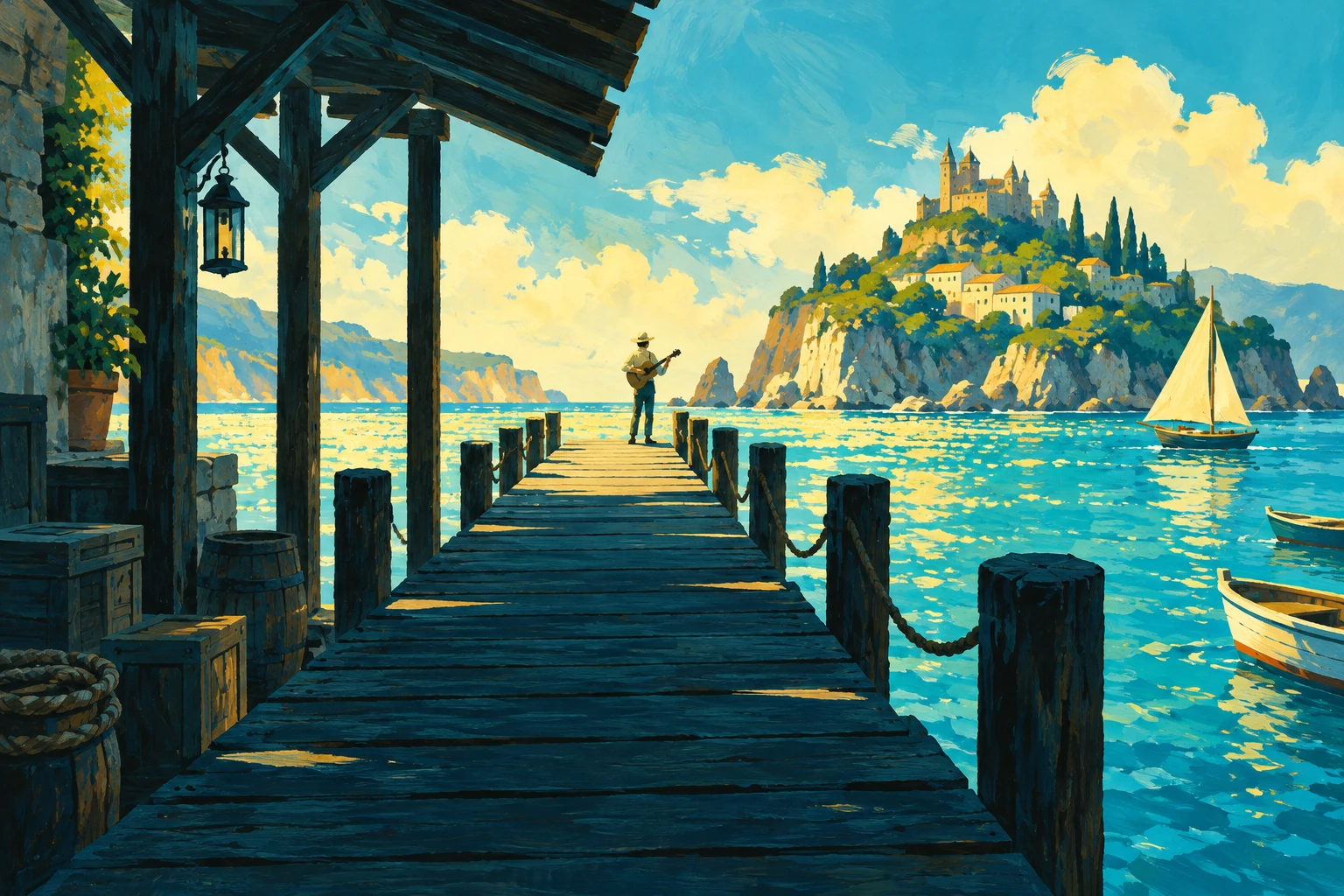
An imaginary island harbour opens beyond a long shaded pier; a distant guitarist stands at the pier end while bright open water answers the long dark approach. The island is a title metaphor and the approach/release expresses dominant-to-tonic expectancy.
An original editorial interpretation of the tune. This is an illustration, not an archival photograph or a documented reconstruction of a recording session.
Original Djangopedia illustration · AI-assisted, 2026
Illustration credits & provenance →Selected performances by notable Gypsy Jazz players and ensembles. Inclusion is editorial and does not imply an objective popularity ranking.
Tcha Limberger, Mozes Rosenberg, Dave Kelbie and Sébastien Girardot · Dave Kelbie
2015 · Jazz à Foix
Festival performance recorded on 23 July 2015, as identified by Dave Kelbie.
If playback is unavailable, use the source link.
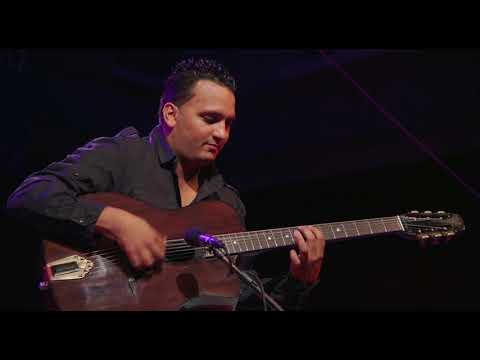 Avalon by The Tcha Limberger Trio with Mozes Rosenberg 2015Tcha Limberger, Mozes Rosenberg, Dave Kelbie and Sébastien Girardot · Dave Kelbie2015 · Jazz à FoixFestival performance recorded on 23 July 2015, as identified by Dave Kelbie.✓ Featured
 Avalon - Gypsy Jazz in Paris by the Romain Vuillemin QuartetRomain Vuillemin Quartet · Romain Vuillemin2024 · Sunset, ParisLive April 2024 quartet performance with Guillaume Singer, Adrien Tarraga and Edouard Pennes.Select performance
 Avalon - Hot Club du NaxHot Club du NaxVocal Gypsy jazz ensembleVocal version with Isobel Cope, guitarists Arian Kindl and Lukas Bamesreiter, Dario Michele Gurrado on bass and Tomas Novak on violin.Select performance
 Jimmy Rosenberg Trio - Avalon - DJANGO Amsterdam 2025 #gypsyjazz #jazz #jazzmanouche #gypsyguitarJimmy Rosenberg, Faifie Reinhardt and Fremdo Rosenberg · Daniel Gueli Gypsy Jazz Channel2025 · Django AmsterdamJimmy Rosenberg Trio performance at Django Amsterdam 2025.Select performance
 Avalon - Jonny Hepbir Trio - UK & International Gypsy Jazz Band HireJonny Hepbir Trio2010 · Brighton recording sessionTrio performance recorded in Brighton in 2010, as identified by the ensemble.Select performance
Use one rhythmic figure for four bars of C7, answer it on F, then repeat the process with fewer notes at a faster tempo.
Keep long C7 spans even and relaxed. A small change of inversion can provide motion without making the soloist hear a new chord every beat.
Start at 110–140; build toward 200–260 bpm
Use one rhythmic figure for four bars of C7, answer it on F, then repeat the process with fewer notes at a faster tempo.
Start below the suggested tempo. First hear four quarter-note clicks, then halve the click rate and place clicks on beats 2 and 4. Keep the same phrase length.
Avalon — F major; 32-bar chorus; two opening eight-bar phrases and a contrasting second half. Agree the tempo, pickup, solo order and ending before the count.
Choose a tempo all players can articulate; the fastest backing track need not be your starting tempo.
Keep bass notes at harmonic landmarks and allow the melody to carry the drive.
Choose a tempo all players can articulate; the fastest backing track need not be your starting tempo.
Choose the singer’s comfortable key, then transpose the whole arrangement, including the introduction. Use the original lyric phrasing to shape breathing.
This player guide combines inherited recording evidence and editorial study notes. Musical study notes are editorial suggestions; compare them with the recording.
Composition background and credits ↗
Guitare Improvisation — backing track ↗
Feature photograph — Gypsy Jazz UK historical archive ↗
Original Djangopedia illustration · AI-assisted, 2026
An original editorial interpretation of the tune. This is an illustration, not an archival photograph or a documented reconstruction of a recording session.
Generated with the native image-generation tool on 2026-10-08; original editorial artwork, not a historical photograph.
Prompt: Use case: illustration-story. One original editorial feature illustration for Djangopedia's guide “Avalon”. Landscape 1536 × 1024, opaque background. Scene: An imaginary island harbour opens beyond a long shaded pier; a distant guitarist stands at the pier end while bright open water answers the long dark approach. The island is a title metaphor and the approach/release expresses dominant-to-tonic expectancy. Musical basis from the guide: A lively standard whose opening waits on the dominant before releasing into the tonic. Long harmonic spans reward rhythmic invention; the contrasting later phrases need a clear sense of direction. The supplied chart is F major; form: 32-bar chorus; two opening eight-bar phrases and a contrasting second half; feel: Swing. These describe musical inspiration, not visible writing. Historical context: Avalon was published in 1920 with credits associated with Vincent Rose, Al Jolson and Buddy DeSylva. Djangopedia’s first listed Django session is 2 March 1935 with Coleman Hawkins and Michel Warlop’s orchestra. It is the early jazz standard, not the later Roxy Music song. Do not illustrate disputed historical claims or suggest this imagined scene is an archival session. Medium: travel-poster gouache. Dominant palette: teal and bright daylight yellow. Composition: deep bay with offset horizon. Human presence: tiny distant figure. Strong intentional design, clearly drawn/painted, distinctive material marks; keep essential subject safely within the central 70 percent width and middle 80 percent height for card crops. Maintain enough visual substance at thumbnail size. Broad inspiration observed in old photo, ONLY scale/rhythm and never a reference image: large solo figure; diagonals of instrument; close framing. Independently invent every pose, perspective, clothing, setting and lighting. Avoid: No seated portrait, famous island view, photographic marina. No photorealism, archival simulation, generated text, letters, numbers, labels, fake musical notation, logo, signature, watermark, fake dates, yellowed-paper patina, recognizable artwork or copied photograph. No imitation of any named artist. Render the art edge to edge without borders, mockup or typography.
Photograph rights are documented separately in its credit. They do not establish the rights status of the composition or recording.