Tune details
Music: George Gershwin
Words: Ballard MacDonald, Buddy DeSylva
Source-attributed publication / composition: 1924
Original key: Not established
Study level: Intermediate; sing one question phrase and answer it on guitar
 Djangopedia
A Gershwin melody for learning musical conversation and leaving purposeful space.
Sing one question phrase and answer it on guitar.
Owner content reviewed — 2026-10-18T23:08:25Z by admin. Coverage measures presence, not accuracy. Content review does not certify rights or musical perfection.
Django recordings for this tune. Uploader dates and take labels remain source claims; only an evidenced exact association enables a row’s Listen control.
Django Reinhardt
source-described; accuracy not independently verified
Uploader identifies this as Django Reinhardt’s performance; recording date and take require comparison with the discography.
| Entry | Year | Recording / session / release evidence | Listen |
|---|---|---|---|
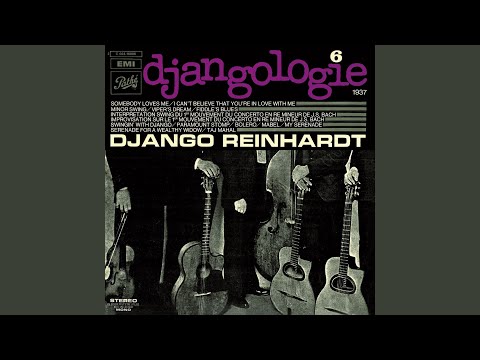
| 01 | 1937 | Somebody Loves Me,OLA 1984-1 ,"Fremeaux 306, Affinity AFS 1003","23/11/37 - Paris - Eddie South (v), Django Reinhardt (g)" | — |
A dash means no video has been associated with this exact historical recording. Tune-level listening resources remain available above.
The Levy sheet-music collection documents the 1924 Gershwin song and its lyric credits. The proposed easy-head lesson is a melody aid; the original Django listening selection is preserved separately.
Music: George Gershwin
Words: Ballard MacDonald, Buddy DeSylva
Source-attributed publication / composition: 1924
Original key: Not established
Study level: Intermediate; sing one question phrase and answer it on guitar
A Gershwin melody for learning musical conversation and leaving purposeful space.
Somebody Loves Me,OLA 1984-1 ,"Fremeaux 306, Affinity AFS 1003","23/11/37 - Paris - Eddie South (v), Django Reinhardt (g)"
Follow the song’s question-and-answer phrasing. Mark the note that settles each answer and build a simple arpeggio around that point after verifying the chosen accompaniment. Check the video key before playing with the chart.
Follow the song’s question-and-answer phrasing. Mark the note that settles each answer and build a simple arpeggio around that point after verifying the chosen accompaniment.
A complete chord chart has not yet been verified. The exercises are editorial listening and practice suggestions, not a replacement score.
No readable chord chart has been added for this title.
Luc Maes
Swing · 190 BPM · 5m43s · Video available when checked; creator-described attribution.
Creator-provided play-along; instrumentation and feel vary by selection. Check the key and full arrangement before joining in; the guide chart may use another key. Tempo is the creator’s stated value.
If playback is unavailable, use the source link.
 BACKING TRACK - SOMEBODY LOVES ME (George Gershwin, Ballard McDonald, B DeSylva) (F) 190 BPM SWINGLuc MaesSwing · 190 BPM · 5m43s · Video available when checked; creator-described attribution.Creator-provided play-along; instrumentation and feel vary by selection. Check the key and full arrangement before joining in; the guide chart may use another key. Tempo is the creator’s stated value.✓ Featured
 Somebody Loves Me - Gypsy Jazz Backing Track 180 BPM - Django ReinhardtHot Club de FranceSwing · 180 BPM · 4m27s · Video available when checked; creator-described attribution.Creator-provided play-along; instrumentation and feel vary by selection. Check the key and full arrangement before joining in; the guide chart may use another key. Tempo is the creator’s stated value.Select video
Performed studies, transcriptions, TAB, notation and lessons for studying Django’s solo. Inclusion does not certify note-for-note accuracy.
No Django solo study aid yet. Know a useful resource — or want to record a study of this solo?
Follow a shared key, a harmonic idea or a familiar form. Keys refer to this site’s chart editions; other recordings may use a different key.
No sufficiently supported harmonic comparison has been added yet.
No match is established in the current chart metadata.
No match is established in the current chart metadata.
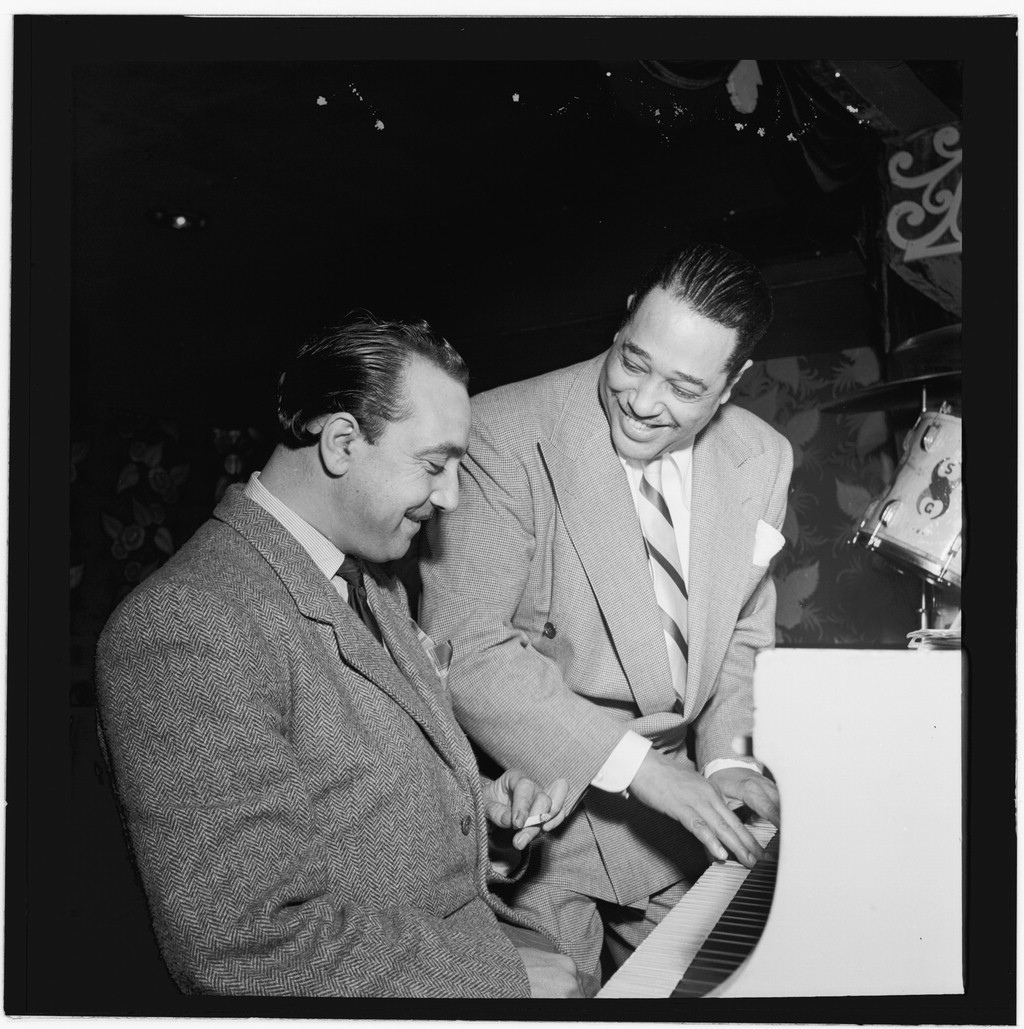
Editorial reuse of a documented public-domain Gottlieb photograph; not a photograph of this tune or recording session. Six photographs are each proposed for two Stage 6D guides.
Part of William P. Gottlieb’s documented Aquarium photographs in New York, circa November 1946. The catalogue supplies the location and approximate date; this is not evidence of a particular tune being played.
Explore this photograph, its context & credits →Selected performances by notable Gypsy Jazz players and ensembles. Inclusion is editorial and does not imply an objective popularity ranking.
Notable Gypsy Jazz performances are being curated.
Sing one question phrase and answer it on guitar. Reverse those roles on the next pass, keeping the rests and breath lengths.
Support the singer or lead instrument with small voicings. Add a fill only after the melody’s answer has finished.
Creator-labelled easy melody study, not a Django solo recreation.
80–120 bpm, then increase gradually
Sing one question phrase and answer it on guitar. Reverse those roles on the next pass, keeping the rests and breath lengths.
Count quarter notes first. Then place the click on beats 2 and 4 at half the click rate, keeping the phrase length unchanged.
Confirm the chosen arrangement key; Confirm the complete form. Agree the arrangement, pickup and ending before counting in.
The lesson’s melody does not authenticate a complete Django solo or an exact historical take.
Keep the melody uppermost and begin with a single bass note under each harmony. Support the singer or lead instrument with small voicings. Add a fill only after the melody’s answer has finished.
Support the singer or lead instrument with small voicings. Add a fill only after the melody’s answer has finished.
Choose a comfortable singing key and transpose the accompaniment as a whole; lyrics are not reproduced here.
This player guide combines inherited recording evidence and editorial study notes. Musical study notes are editorial suggestions; compare them with the recording.
Djangopedia full discography ↗
Credit / historical reference ↗
Inherited Djangopedia chart and recording evidence
William P. Gottlieb / Library of Congress · Aquarium, New York · circa November 1946
Public domain (PD-Gottlieb)
Photograph source ↗ · Rights details ↗Used to illustrate Django’s life; no connection to this tune’s recording session is claimed.