
Tune details
Music: Clarence Williams, Spencer Williams
Documented in archive: Not established
Original key: Not established
Study level: Intermediate; mark the first bar of each strain on paper
 Djangopedia
A multi-strain blues study for players ready to move beyond a single repeating twelve-bar loop.
Mark the first bar of each strain on paper.
Owner content reviewed — 2026-10-18T23:08:30Z by admin. Coverage measures presence, not accuracy. Content review does not certify rights or musical perfection.
Django recordings for this tune. Uploader dates and take labels remain source claims; only an evidenced exact association enables a row’s Listen control.
Django Reinhardt
source-described; accuracy not independently verified
Uploader identifies this as Django Reinhardt’s performance; recording date and take require comparison with the discography.
| Entry | Year | Recording / session / release evidence | Listen |
|---|---|---|---|
| 01 | — | Royal Garden Blues,CW16,"Fremeaux FA 318, RCA ND 70929-2, Dejavu CD 32","1950 - Rome - Django Reinhardt (elg), Andre Ekyan (as,cl), Ralph Schecroun (p) Alf Masselier (b), Roger Paraboschi (d)" | — |
A dash means no video has been associated with this exact historical recording. Tune-level listening resources remain available above.
The Library of Congress recording catalogue credits Clarence and Spencer Williams. This is a multi-strain blues tune; the inherited chart prints a longer arranged sequence rather than one repeating twelve-bar grid.
Music: Clarence Williams, Spencer Williams
Documented in archive: Not established
Original key: Not established
Study level: Intermediate; mark the first bar of each strain on paper
A multi-strain blues study for players ready to move beyond a single repeating twelve-bar loop.
Royal Garden Blues,CW16,"Fremeaux FA 318, RCA ND 70929-2, Dejavu CD 32","1950 - Rome - Django Reinhardt (elg), Andre Ekyan (as,cl), Ralph Schecroun (p) Alf Masselier (b), Roger Paraboschi (d)"
Separate the F-based material from the later B-flat strain. The progression includes diminished passing chords and secondary dominants; label the strain transitions before treating any one segment as a solo chorus. Check the video key before playing with the chart.
Separate the F-based material from the later B-flat strain. The progression includes diminished passing chords and secondary dominants; label the strain transitions before treating any one segment as a solo chorus.
Inherited archive chart retained without harmonic or notation edits. The playing notes below discuss this particular version, not a definitive score.
| F/// | F/// | F/// | F7/// |

| Bb7/// | Bb7/// | Bb7/// | G7/// |

| C7/// | C7/// | F/ Bb7/ | F/ C7/ |

| F7/// | F7/// | F7/// | F7/// |

| Bb/// | B0/// | F/// | D7/// |

| G7/// | C7/// | F/ Bb7/ | F/ C7/ |

| F7/// | F7/// | F7/// | F7/// |

| Bb/// | Eb7/// | Bb/// | Bb7/// |

| Eb/// | E0/// | Bb/// | G7/// |

| C7/// | F7/// | Bb/ B0/ | Cm7/ F7/ :||
Original source ↗
Gypsy Jazz Play Along
3m20s · Video available when checked; creator-described attribution.
Creator-provided play-along; instrumentation and feel vary by selection. Check the key and full arrangement before joining in; the guide chart may use another key.
If playback is unavailable, use the source link.
Performed studies, transcriptions, TAB, notation and lessons for studying Django’s solo. Inclusion does not certify note-for-note accuracy.
No Django solo study aid yet. Know a useful resource — or want to record a study of this solo?
Follow a shared key, a harmonic idea or a familiar form. Keys refer to this site’s chart editions; other recordings may use a different key.
No sufficiently supported harmonic comparison has been added yet.
No match is established in the current chart metadata.
No match is established in the current chart metadata.
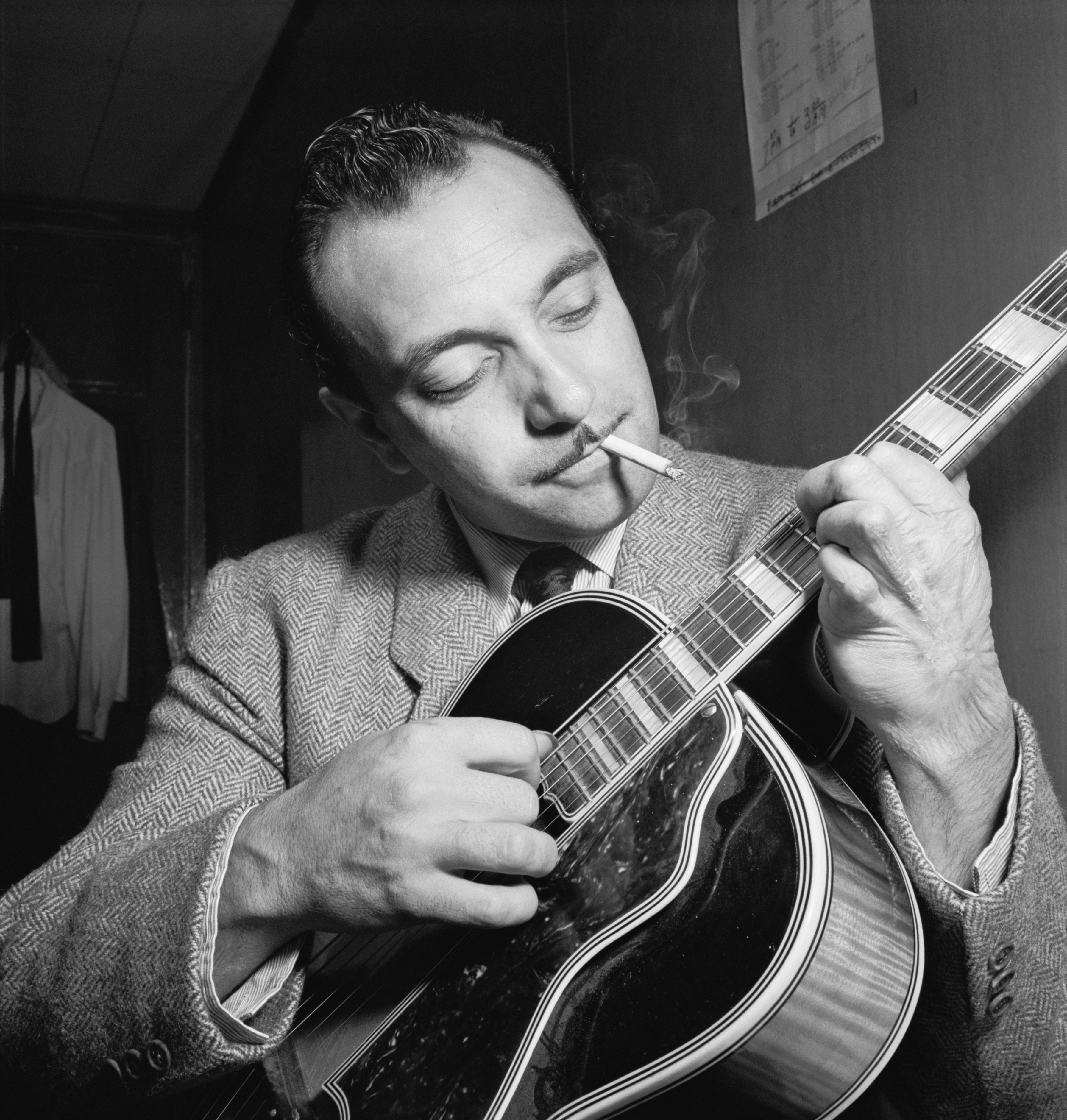
Editorial reuse of a documented public-domain Gottlieb photograph; not a photograph of this tune or recording session. Six photographs are each proposed for two Stage 6D guides.
Part of William P. Gottlieb’s documented Aquarium photographs in New York, circa November 1946. The catalogue supplies the location and approximate date; this is not evidence of a particular tune being played.
Explore this photograph, its context & credits →Selected performances by notable Gypsy Jazz players and ensembles. Inclusion is editorial and does not imply an objective popularity ranking.
Josep Traver
Video available when checked; creator-described attribution.
Performer attribution follows the video title and channel description. Proposed listening selection; no popularity ranking implied.
If playback is unavailable, use the source link.
 Royal garden blues: Farràs / Font / Regada / TraverJosep TraverVideo available when checked; creator-described attribution.Performer attribution follows the video title and channel description. Proposed listening selection; no popularity ranking implied.✓ Featured
 "ROYAL GARDEN BLUES": JAKE SANDERS QUINTETswingyoucatsVideo available when checked; creator-described attribution.Performer attribution follows the video title and channel description. Proposed listening selection; no popularity ranking implied.Select video
Mark the first bar of each strain on paper. Practise the transition from the F material to the B-flat section using only roots and melody landing notes.
Use clear but light changes at strain boundaries. Agree which strain will be used for solos and how the band returns to the head.
100–160 bpm
Mark the first bar of each strain on paper. Practise the transition from the F material to the B-flat section using only roots and melody landing notes.
Count quarter notes first. Then place the click on beats 2 and 4 at half the click rate, keeping the phrase length unchanged.
F / Bb; 40 printed bars in the inherited multi-strain arrangement. Agree the arrangement, pickup and ending before counting in.
The forty printed bars describe this inherited arrangement, not a universal form for every recording.
Keep the melody uppermost and begin with a single bass note under each harmony. Use clear but light changes at strain boundaries. Agree which strain will be used for solos and how the band returns to the head.
Use clear but light changes at strain boundaries. Agree which strain will be used for solos and how the band returns to the head.
No vocal arrangement is prescribed; use the instrumental melody as the phrasing reference.
Search online videos of "Royal Garden Blues" in youtube.com ↗
This player guide combines inherited recording evidence and editorial study notes. Musical study notes are editorial suggestions; compare them with the recording.
Credit / historical reference ↗
Inherited Djangopedia chart and recording evidence ↗
William P. Gottlieb / Library of Congress / restoration by Adam Cuerden · Aquarium, New York, N.Y. · circa November 1946
Gottlieb collection photographs entered the public domain on February 16, 2010, according to the source file page.
Photograph source ↗ · Rights details ↗Used to illustrate Django’s life; no connection to this tune’s recording session is claimed.
