
Tune details
Music: Django Reinhardt
Documented in archive: 1940
Original key: Not established
Study level: Intermediate listening study; arrangement and source awareness
 Djangopedia
The publisher spells this title Oiseaux des Iles and includes it among Django's December 1940 pieces. Compare the melody's first clear statement with its later return, paying attention to pickups and phrase endings.
Sing a short melody fragment, play its rhythm on a muted string, then restore the pitches while preserving the rests.
Owner content reviewed — 2026-10-20T01:43:23Z by admin. Coverage measures presence, not accuracy. Content review does not certify rights or musical perfection.
Django recordings for this tune. Uploader dates and take labels remain source claims; only an evidenced exact association enables a row’s Listen control.
Django Reinhardt
source-described; accuracy not independently verified
Uploader identifies this as Django Reinhardt’s performance; recording date and take require comparison with the discography.
| Entry | Year | Recording / session / release evidence | Listen |
|---|---|---|---|
| 01 | 1940 | Oiseaux de Iles,OSW 156-1 ,"Fremeaux FA 310, Classics 852, Affinity AFS 1003, Jazz Time 252707-2, Music Memoria 31005, Suisa JZCD 376, OR 0062, Mosaic MD6-190(6 CD Set).","17/12/40 - Paris - QHCF+ - Hubert Rostaing (cl), Alix Combelle (cl,ts) Django & Joseph Reinhardt (g), Tony Rovira (b), Pierre Fouad (d)" | — |
A dash means no video has been associated with this exact historical recording. Tune-level listening resources remain available above.
The publisher spells this title Oiseaux des Iles and includes it among Django's December 1940 pieces.
Music: Django Reinhardt
Documented in archive: 1940
Original key: Not established
Study level: Intermediate listening study; arrangement and source awareness
Compare the melody's first clear statement with its later return, paying attention to pickups and phrase endings. Source-attributed credits: Django Reinhardt in the publisher track list.
A complete harmonic route is not established here. First sing the melody and mark phrase endings; verify the underlying chords from a reliable edition before adding substitutions.
No verified complete chart is supplied. The listening and practice notes do not stand in for a chord chart.
No readable chord chart has been added for this title.
No backing track has been added.
Performed studies, transcriptions, TAB, notation and lessons for studying Django’s solo. Inclusion does not certify note-for-note accuracy.
No Django solo study aid yet. Know a useful resource — or want to record a study of this solo?
Follow a shared key, a harmonic idea or a familiar form. Keys refer to this site’s chart editions; other recordings may use a different key.
No sufficiently supported harmonic comparison has been added yet.
No match is established in the current chart metadata.
No match is established in the current chart metadata.
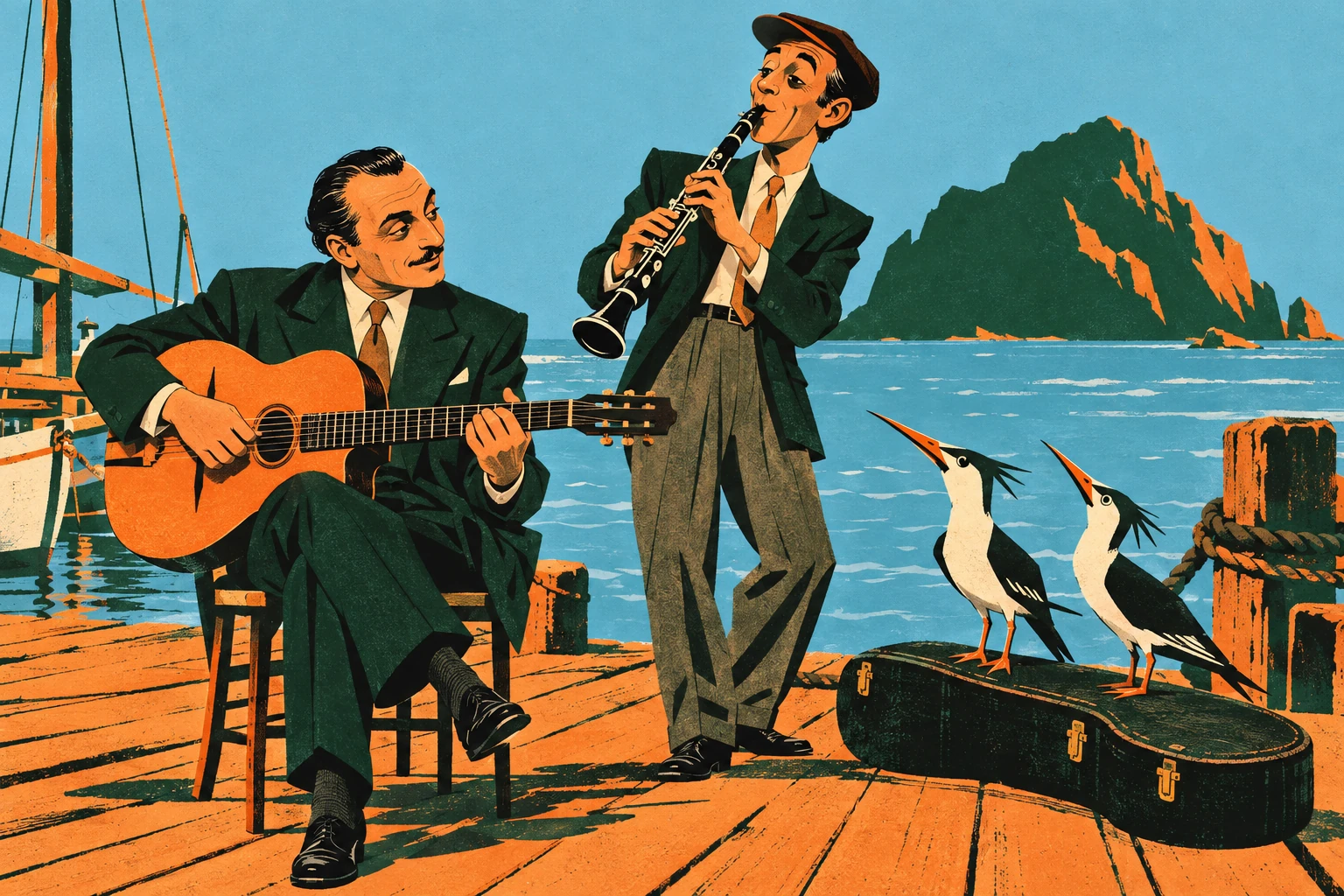
This image is an editorial illustration; a connection to this recording has not been established.
Original AI-assisted editorial artwork inspired by the tune’s mood; not a documented historical scene.
Original AI-assisted illustration created for Djangopedia
Illustration credits & provenance →Selected performances by notable Gypsy Jazz players and ensembles. Inclusion is editorial and does not imply an objective popularity ranking.
Notable Gypsy Jazz performances are being curated.
Sing a short melody fragment, play its rhythm on a muted string, then restore the pitches while preserving the rests.
Use the melody's breathing points to decide where the accompaniment should become quieter.
60–90 quarter-note BPM for short study fragments; slow the source as needed
Sing a short melody fragment, play its rhythm on a muted string, then restore the pitches while preserving the rests.
Use a quiet quarter-note click for short loops. Keep the preceding rest and the next entry in the loop; remove the click briefly to test internal time.
Confirm the composition identity, concert key and complete arrangement before calling the tune. Agree pickup and ending together.
The game's soundtrack upload is a reuse of Django's recording, not a modern Gypsy-jazz performance.
Begin with the melody alone, then add only independently established bass arrivals. Use the melody's breathing points to decide where the accompaniment should become quieter.
Use the melody's breathing points to decide where the accompaniment should become quieter.
Follow the song’s breathing where a vocal version exists. Establish the singer’s key independently; lyrics are not reproduced here.
This player guide combines inherited recording evidence and editorial study notes. Musical study notes are editorial suggestions; compare them with the recording.
Djangopedia full discography ↗
Reissue publisher booklet and track listing ↗
Original AI-assisted illustration created for Djangopedia
Original AI-assisted editorial artwork inspired by the tune’s mood; not a documented historical scene.
Generated with the native image-generation tool on 2026-10-20; original editorial artwork, not a historical photograph.
Prompt: Use case: stylized-concept. Asset: one original Djangopedia tune illustration, landscape 1536x1024, 3:2. Title context (DO NOT WRITE TEXT): Oiseaux de Iles. Scene: Two angular seabirds perch on a guitar case beside a guitarist and clarinetist on a plain dock. Their beaks echo the clarinet shape; a single bold island silhouette. Style: humorous mid-century 1950s cartoon serigraph, confident chunky contours, simplified flat separate ink shapes, mildly exaggerated head/hand proportions and witty poses. More dry and graphic, less romantic than a lyrical jazz poster. Limited palette: bottle green, orange ochre, pale blue and black. Small controlled ink misregistration and occasional dry-print texture, large clean shapes, crisp asymmetrical composition. Faces: where the guitarist is Django-like, use documented Django Reinhardt portrait traits: swept-back dark hair, small pencil moustache, mature expressive face and dapper 1930s/1940s suit. Supporting musicians are varied individual adults in historically informed Manouche jazz-circle clothing, not generic modern models. Expressive cartoon acting must not exaggerate ethnicity or use stereotypical racial features or costumes. All heads, hands and instrument bodies inside frame, convincing basic instrument anatomy. No text, letters, numerals, music notation, logos, watermark, border, photorealism, gradients, dreamy sunset, hearts or soft romantic haze. Imagined editorial scene, not a claimed historical event. Entirely original composition, not a reproduction of any artist's print.