
Tune details
Music: Maceo Pinkard
Words: Sidney D. Mitchell, Edna Alexander
Documented in archive: 1940
Original key: Not established
Study level: Intermediate; melody, pulse and arrangement awareness
 Djangopedia
A source-comparison study that distinguishes song identity from an inherited chord grid.
Compare the first phrase and final cadence of the Django recording with the proposed transcription.
Owner content reviewed — 2026-10-19T04:10:10Z by admin. Coverage measures presence, not accuracy. Content review does not certify rights or musical perfection.
Django recordings for this tune. Uploader dates and take labels remain source claims; only an evidenced exact association enables a row’s Listen control.
Django Reinhardt
source-described; accuracy not independently verified
Uploader identifies this as Django Reinhardt’s performance; recording date and take require comparison with the discography.
| Entry | Year | Recording / session / release evidence | Listen |
|---|---|---|---|
| 01 | — | Sugar, 1937 December 21, OLA 2219-1 ,"Fremeaux 307, Affinity AFS 1003, Classics 708, Jazz Time 789604-2, Mosaic MD6-190(6 CD Set).","Stephane Grappelly (v), Django Reinhardt (g) | — |
| 02 | 1940 | Sugar, 22/2/40, OSW 115-1 ,"Fremeaux FA 310, Classics 831, EMI 780671-2"," - Paris - Andre Ekyan(as),Django & Joseph Reinhardt(g),Emmanuel Soudieux(b)" | — |
A dash means no video has been associated with this exact historical recording. Tune-level listening resources remain available above.
The publisher credits Pinkard for the 1940 entry. The inherited typed chart is a 16-bar C-minor grid; its agreement with the song and selected recording has not been established, so it is not presented as an authenticated arrangement.
Music: Maceo Pinkard
Words: Sidney D. Mitchell, Edna Alexander
Documented in archive: 1940
Original key: Not established
Study level: Intermediate; melody, pulse and arrangement awareness
A source-comparison study that distinguishes song identity from an inherited chord grid.
Sugar, 1937 December 21, OLA 2219-1 ,"Fremeaux 307, Affinity AFS 1003, Classics 708, Jazz Time 789604-2, Mosaic MD6-190(6 CD Set).","Stephane Grappelly (v), Django Reinhardt (g)
Treat the displayed grid as unverified source material. It contains repeated Cm–Dm7b5–G7 and a move to Fm; compare the actual melody and chorus length before using it for this song.
Inherited chart retained exactly. Harmonic comments refer to this edition; ambiguous symbols are flagged rather than silently corrected.
| Cm/// | Dm7b5/ G7/ | Cm/// | Dm7b5/ G7/ |

| Cm/// | Dm7b5/ G7/ | Cm/// | Dm7b5/ G7/ |

| Cm/// | Cm/// | Fm/// | Eb7/// |

| Dm7b5/// | G7+/// | Cm/// | Dm7b5/ G7/ :||
Original source ↗No backing track has been added.
Performed studies, transcriptions, TAB, notation and lessons for studying Django’s solo. Inclusion does not certify note-for-note accuracy.
Miguel Mateu Jazz Guitar
Video available when checked; creator-described attribution.
Creator-presented transcription of Django’s solo. This is a study aid, not an independent certification of note-for-note accuracy.
If playback is unavailable, use the source link.
Follow a shared key, a harmonic idea or a familiar form. Keys refer to this site’s chart editions; other recordings may use a different key.
No sufficiently supported harmonic comparison has been added yet.
No match is established in the current chart metadata.
No match is established in the current chart metadata.
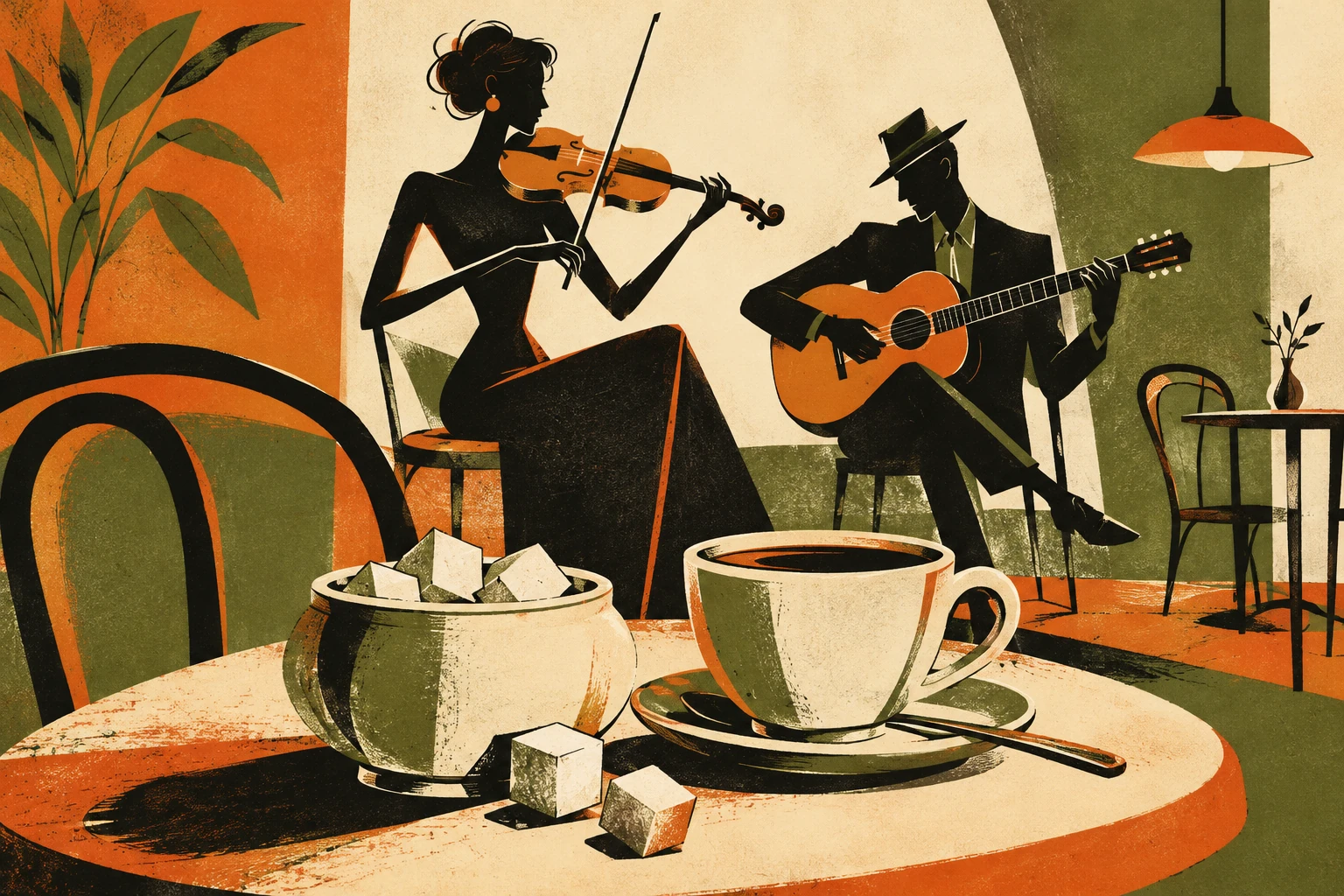
A small sugar bowl and coffee cup in the foreground of a cafe, with a violinist and guitarist reduced to bold silhouettes behind; a few geometric sugar cubes.
Original AI-assisted editorial artwork inspired by the tune’s mood. It does not depict a documented historical event.
Original AI-assisted illustration created for Djangopedia
Illustration credits & provenance →Selected performances by notable Gypsy Jazz players and ensembles. Inclusion is editorial and does not imply an objective popularity ranking.
Notable Gypsy Jazz performances are being curated.
Compare the first phrase and final cadence of the Django recording with the proposed transcription. Use only an arrangement whose melody and form agree; practise a short phrase by ear meanwhile.
Accompany the verified song version sparsely. Do not impose the inherited C-minor loop when the lead is following another harmonic form.
80–120 bpm, then increase gradually
Compare the first phrase and final cadence of the Django recording with the proposed transcription. Use only an arrangement whose melody and form agree; practise a short phrase by ear meanwhile.
Count quarter notes first. Then place the click on beats 2 and 4 at half the click rate, keeping the phrase length unchanged.
Confirm the chosen arrangement key; Confirm the complete form. Agree the arrangement, pickup and ending before counting in.
Sugar is a common title. The archive chart and Pinkard attribution require reconciliation before calling a key or form.
Keep the melody uppermost and begin with a single bass note under each harmony. Accompany the verified song version sparsely. Do not impose the inherited C-minor loop when the lead is following another harmonic form.
Accompany the verified song version sparsely. Do not impose the inherited C-minor loop when the lead is following another harmonic form.
Choose a comfortable singing key and transpose the accompaniment as a whole; lyrics are not reproduced here.
This player guide combines inherited recording evidence and editorial study notes. Musical study notes are editorial suggestions; compare them with the recording.
Reissue publisher discography and credits ↗
Inherited chart and recording evidence ↗
Original AI-assisted illustration created for Djangopedia
Original AI-assisted editorial artwork inspired by the tune’s mood. It does not depict a documented historical event.
Generated with the native image-generation tool on 2026-10-19; original editorial artwork, not a historical photograph.
Prompt: Use case: stylized-concept. Asset: horizontal 1536x1024, 3:2 Djangopedia tune illustration for Sugar. Original scene: A small sugar bowl and coffee cup in the foreground of a cafe, with a violinist and guitarist reduced to bold silhouettes behind; a few geometric sugar cubes. Medium: authentic-feeling 1950s silk-screen editorial print, flat separate ink layers, boldly simplified shapes, long expressive angular silhouettes, spare wiry line accents, off-register overlaps, small areas of crosshatching, slight dry ink and paper texture. Strong asymmetric composition with generous negative space; witty and musical, sophisticated rather than children's cartoon. Limited palette: olive green, burnt orange, warm cream and black. All heads and instrument bodies wholly inside frame unless otherwise specified. No letters, words, numbers, captions, borders, logos, watermark, realistic shading, gradients or photographed paper. Invent an entirely new composition, not a reproduction of any existing print. No claim of a documented historical scene.
